
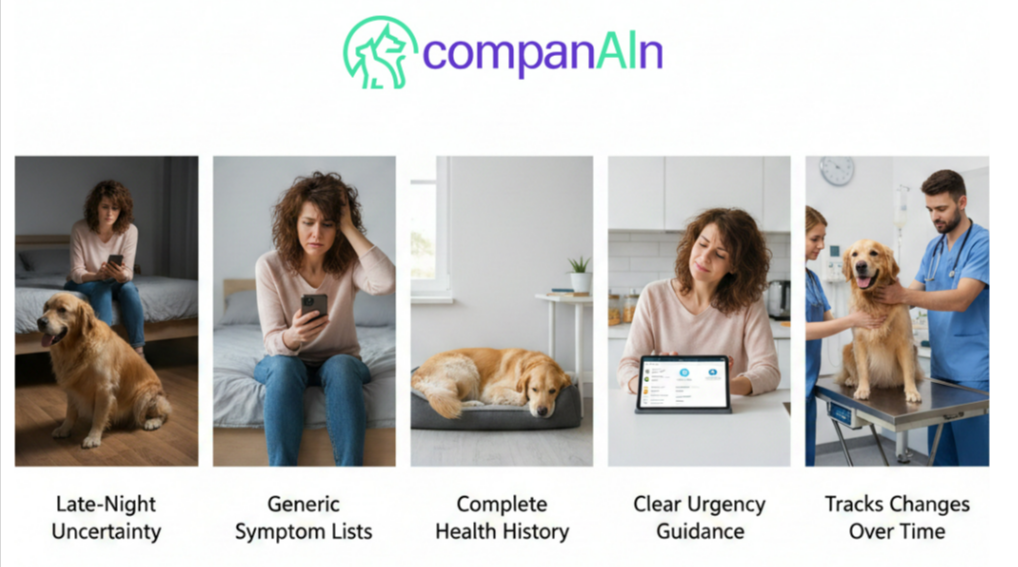
It’s three AM, your dog’s panting heavily, pacing the bedroom, and refusing to lie down. You grab your phone, searching for answers while anxiety builds. Traditional symptom checkers offer static lists of possibilities without guidance on whether this requires an emergency vet visit now or observation until your regular clinic opens in six hours.
The gap between recognizing something’s wrong and knowing what to do about it creates the most stressful moments of pet ownership. Generic symptom databases can’t interpret whether restlessness with panting indicates life-threatening bloat, manageable anxiety, or pain from a minor injury. They list dozens of conditions matching “restlessness” without contextual intelligence to determine actual urgency.
CompanAIn’s agentic AI transforms this experience through intelligent systems that analyze symptoms within your dog’s complete health history, breed risks, and documented behavior patterns—providing veterinary-grade triage guidance 24/7 when you need answers most.
The Problem With Static Symptom Databases
Type “dog vomiting” into any traditional symptom checker and you’ll encounter alphabetized lists containing everything from dietary indiscretion to pancreatitis, kidney failure, bloat, poisoning, and intestinal obstruction. Without context, these tools generate anxiety rather than clarity. CompanAIn’s platform addresses this gap by maintaining complete health context for every assessment.
Why keyword matching fails:
- Static databases cannot evaluate frequency—whether this represents your dog’s first vomiting episode in years or the fifth this week makes an enormous difference in urgency, but simple keyword tools treat both identically.
- They ignore progression velocity—symptoms developing suddenly over hours versus gradually over days require completely different responses. Acute onset suggests injury or obstruction; gradual development indicates chronic disease.
- Breed, age, and individual history get overlooked entirely. A 10-year-old Golden Retriever showing decreased activity likely has arthritis. The same symptom in a 2-year-old suggests acute illness or injury. Traditional checkers present identical results for both scenarios.
How Agentic AI Delivers Veterinary-Grade Intelligence
The term “agentic” distinguishes collaborative multi-agent systems from simple algorithms. According to veterinary AI research, agentic architectures deploy specialized AI components—each agent handles distinct analytical tasks, sharing insights to generate comprehensive assessments beyond what any single algorithm achieves.
Three Specialized Agents Working in Concert
The Data Integration Agent aggregates information from multiple sources simultaneously. Veterinary records uploaded as PDFs or photos get parsed for diagnoses, medications, and lab results. Daily observations you log—food intake, activity levels, elimination patterns—build behavioral baselines. Environmental factors like travel, boarding, or household changes get timestamped and contextualized.
This agent doesn’t just store data—it identifies relationships. When you log “decreased appetite,” the agent cross-references current medications (some cause nausea), recent vet visits (was pain medication prescribed that just ran out?), and historical patterns (does appetite drop every spring during allergy season?).
The Clinical Analysis Agent employs veterinary medical knowledge to interpret symptoms within your dog’s specific context. This goes far beyond keyword matching. When analyzing vomiting, this agent evaluates:
- Content characteristics (bile, undigested food, blood)
- Timing relative to meals
- Frequency and pattern
- Accompanying symptoms (lethargy, diarrhea, fever indicators)
- Breed predispositions (breeds prone to bloat, sensitive stomachs, megaesophagus)
- Age-related disease probabilities
- Current medications and potential side effects
According to Cornell University College of Veterinary Medicine research, accurate symptom interpretation requires this multifactorial analysis rather than simple symptom-to-disease matching.
The Triage Decision Agent synthesizes inputs from both previous agents, generating specific urgency guidance with reasoning transparency. Rather than just stating “seek emergency care,” effective agentic systems explain which combination of factors triggered that recommendation, allowing you to understand the logic and make informed decisions.
Licensed Veterinary Oversight
Technology handles pattern recognition and data processing, but critical decisions receive veterinary review. When agentic AI identifies ambiguous cases or potentially serious conditions, licensed veterinarians examine the analysis before triage guidance is provided. This hybrid approach combines computational thoroughness with professional clinical judgment.
How Agentic AI Triage Works: Example Scenarios
To illustrate how multi-agent AI systems analyze symptoms differently than keyword-based checkers, consider how agentic technology would approach these common situations. These examples demonstrate the contextual analysis that separates intelligent triage from simple symptom matching.
Scenario 1: Acute Vomiting
Situation: Your dog vomited three times overnight. The first was an undigested dinner. The second and third were yellow bile.
Traditional symptom checker: Lists 20+ possible causes, ranging from eating too fast to kidney failure. No urgency guidance.
Agentic AI analysis:
- Cross-references medication list (no nausea-causing drugs)
- Reviews eating patterns (dinner consumed normally, no dietary changes)
- Checks historical data (no vomiting episodes in past 6 months)
- Evaluates breed risks (Labrador—prone to dietary indiscretion but not bloat)
- Assesses accompanying symptoms (maintaining normal behavior between episodes)
Triage guidance: Monitor at home for 12 hours. Withhold food until vomiting stops. Offer water in small amounts. Seek same-day care if vomiting continues beyond 12 hours, if lethargy develops, or if blood appears.
Reasoning: Acute vomiting with bile suggests stomach irritation, likely from dietary indiscretion or mild gastritis. The pattern (undigested food, then bile) supports this. Normal behavior between episodes reduces concern for systemic illness. Breed doesn’t indicate bloat risk. No medication interactions present.
Scenario 2: Sudden Limping
Situation: Your 8-year-old German Shepherd started limping on her right rear leg this morning. She can bear weight but favors the leg significantly.
Traditional symptom checker: Lists arthritis, hip dysplasia, torn ACL, muscle strain, bone cancer, paw injury. No differentiation.
Agentic AI analysis:
- Reviews breed (German Shepherds—high hip dysplasia and degenerative myelopathy risk)
- Checks age (8 years—arthritis likely, but acute onset unusual for arthritis alone)
- Examines activity history (long hike yesterday per your activity log)
- Assesses severity (bearing weight suggests less severe than complete tear)
- Cross-references medical history (diagnosed with mild hip dysplasia 2 years ago, managed with supplements)
Triage guidance: Schedule appointment within 2-3 days unless symptoms worsen. Restrict activity—no running, jumping, or stairs. Continue joint supplements. Monitor for increased pain, inability to bear weight, or swelling. CompanAIn’s Living Health Timeline tracks activity patterns, making it easier to identify when movement changes signal emerging problems.
Reasoning: Sudden onset after strenuous activity suggests muscle strain or minor soft tissue injury rather than progression of known hip dysplasia. Ability to bear weight reduces concern for fracture or complete ligament tear. Given breed and age, a veterinary examination is necessary to rule out ACL injury, but urgency allows a scheduled appointment unless symptoms progress.
Scenario 3: Increased Thirst and Urination
Situation: You’ve been refilling your dog’s water bowl 3-4 times daily instead of once. You’re also taking him out more frequently for urination.
Traditional symptom checker: Lists diabetes, kidney disease, Cushing’s disease, urinary tract infection, liver disease. No context on urgency or likelihood.
Agentic AI analysis:
- Reviews timeline (gradual increase over 2-3 weeks per your logs)
- Checks age (9-year-old male Cocker Spaniel)
- Examines weight trends (stable over past months)
- Assesses appetite (normal)
- Reviews breed predispositions (Cocker Spaniels are prone to diabetes and hypothyroidism)
- Cross-references recent lab work (none in past year)
Triage guidance: Schedule a veterinary appointment within 3-5 days for blood work and urinalysis. Continue monitoring water intake quantity. Watch for appetite changes, weight loss, or lethargy.
Reasoning: Gradual onset over weeks indicates a chronic condition rather than an acute infection. Age and breed increase diabetes probability. Stable weight and normal appetite suggest early-stage disease before significant metabolic decompensation. Requires diagnostic testing but not emergency intervention. Early diagnosis improves treatment outcomes significantly. CompanAIn’s trend detection capabilities flag gradual changes like this that owners might otherwise overlook
What 24/7 Access Actually Means
Veterinary emergencies don’t respect business hours. The agentic technology provides consistent analytical capability regardless of time—the same comprehensive assessment at 3 AM as at 3 PM.
This matters enormously for decision-making during off-hours when emergency veterinary care costs 2-3 times regular appointments. Intelligent triage helps determine whether symptoms truly require emergency intervention or can wait for scheduled care, potentially saving hundreds of dollars while ensuring dogs receive appropriate care timing.
Building Better Health Context Over Time
Static databases never improve or adapt to individual animals. Advanced agentic AI platforms can build increasingly comprehensive health profiles as more data accumulates—tracking how specific symptom patterns have manifested in your individual dog over months and years.
This growing historical context enables more personalized assessment of new symptoms based on your dog’s unique health trajectory rather than generic population data alone.
Integration With Veterinary Care
When veterinary appointments occur, CompanAIn generates comprehensive summaries consolidating symptom timelines with specific observations, medication history, diet information, activity changes, and environmental factors. This documentation ensures veterinarians receive complete information without relying on owner memory during appointments.
Veterinarians consistently report that detailed symptom timelines improve diagnostic accuracy while reducing appointment time spent gathering history. This efficiency benefits clinical outcomes and allows more time for examination and discussion.
Pattern Recognition Beyond Single Episodes
The most powerful application extends beyond individual symptom triage to longitudinal health monitoring. By tracking behaviors over months and years—weight, appetite, activity, elimination patterns—agentic systems detect subtle progressive changes indicating developing disease before obvious symptoms appear.
Gradual weight loss of 0.5 pounds monthly seems negligible but represents significant change over six months. Slowly decreasing activity levels might indicate advancing arthritis pain before lameness becomes obvious. These trends become visible only through systematic tracking that human memory cannot reliably provide.
CompanAIn’s Living Memory technology maintains complete health context across years, enabling the agentic AI to identify these patterns and alert owners to concerning trends warranting veterinary discussion before crises develop.
Getting Started With Intelligent Symptom Analysis
Effective use requires building a comprehensive health history over time. Begin by uploading all available veterinary records—past diagnoses, lab results, medication lists, and vaccination records establish baseline health status.
Document current observations specifically rather than interpretively. “Left half of breakfast uneaten, finished dinner normally” provides more useful information than “decreased appetite.” “Took three breaks during the usual 20-minute walk and sat down twice” beats “seemed tired.”
As you build this documentation over weeks, the agentic AI establishes personalized baselines for your individual dog—what’s normal specifically for your pet rather than generalized canine norms that may not apply.
When symptoms develop, the system contextualizes them against this baseline, determining whether changes represent significant deviations or fall within normal variation. This personalized approach provides dramatically more accurate triage than generic symptom matching.
Frequently Asked Questions
How accurate are AI dog symptom checkers compared to veterinarian assessment?
Research on veterinary AI triage systems shows accuracy rates ranging from 80-90% for identifying critical cases when a comprehensive health history is available, according to studies published in veterinary journals. However, only veterinarians can diagnose conditions through physical examination and diagnostic testing.
Can the system handle multiple symptoms at once?
Yes. Agentic AI excels at analyzing symptom combinations that keyword-based checkers cannot interpret. When dogs show multiple concurrent symptoms—vomiting with lethargy and decreased appetite, for example—the system evaluates whether these clusters suggest specific conditions, how symptom combinations affect urgency, and whether certain patterns indicate serious illness requiring immediate care versus minor issues allowing home monitoring.
What happens if I disagree with the triage recommendation?
Always trust your judgment. If you’re concerned enough to seek veterinary care, that concern justifies evaluation regardless of triage assessment. The system provides data-driven guidance based on documented information, but you observe nuances no algorithm captures. Consider triage recommendations as additional perspective, not as a replacement for your knowledge of your dog or professional veterinary evaluation when you feel it’s warranted.
Does this work during true emergencies like bloat or poisoning?
For known life-threatening emergencies—bloat symptoms (distended abdomen, unproductive retching), suspected poisoning, inability to breathe, seizures, collapse—proceed directly to emergency veterinary care without delay. Symptom checkers are most valuable for ambiguous situations where urgency isn’t obvious. When you know something is critically wrong, immediate veterinary intervention takes priority over symptom analysis.
How does the system improve over time?
As you document more health history and upload veterinary visit outcomes, the agentic AI refines its understanding of your dog’s specific patterns. If certain symptoms consistently resolve without intervention while others require veterinary care, the system learns these patterns for your individual dog. Additionally, when veterinary diagnoses are uploaded after appointments, outcome data helps improve triage accuracy for future similar presentations.
CompanAIn’s Living Memory technology builds increasingly accurate baselines specific to your dog, with all system refinements reviewed by veterinary professionals.