
Why Equine Health Monitoring Needs Intelligence Beyond DatabasesHow Agentic AI Analyzes Equine HealthSpecialized Agents for Equine AnalysisVeterinary Oversight Maintains Clinical StandardsReal-World Applications in Stable ManagementEarly Colic DetectionLameness Progression TrackingMetabolic Condition ManagementReproductive Cycle OptimizationMulti-Horse Management EfficiencyIntegration With Veterinary PracticePrivacy and Data SecurityThe Future of Equine Health IntelligenceTransform Your Stable’s Health Monitoring TodayHow does equine AI differ from standard veterinary record systems?Can AI detect colic before obvious symptoms appear?Is this technology practical for small farms with just a few horses?What happens to the data if I sell a horse?Does this replace regular veterinary care?
Decreased feed consumption over 48 hours. Standing away from the gate. No obvious colic symptoms, yet something’s off. Every barn manager and horse owner knows this scenario—the gut-level recognition that behavioral changes signal developing problems, paired with uncertainty about whether the situation warrants emergency veterinary evaluation or just careful observation through the night.
Horses hide pain instinctively—a prey animal behavior that masks illness until conditions become severe. Subtle changes in appetite, attitude, or movement patterns often signal serious problems developing, but distinguishing meaningful deviations from normal variation requires baseline knowledge that memory alone struggles to maintain across multiple horses over months.
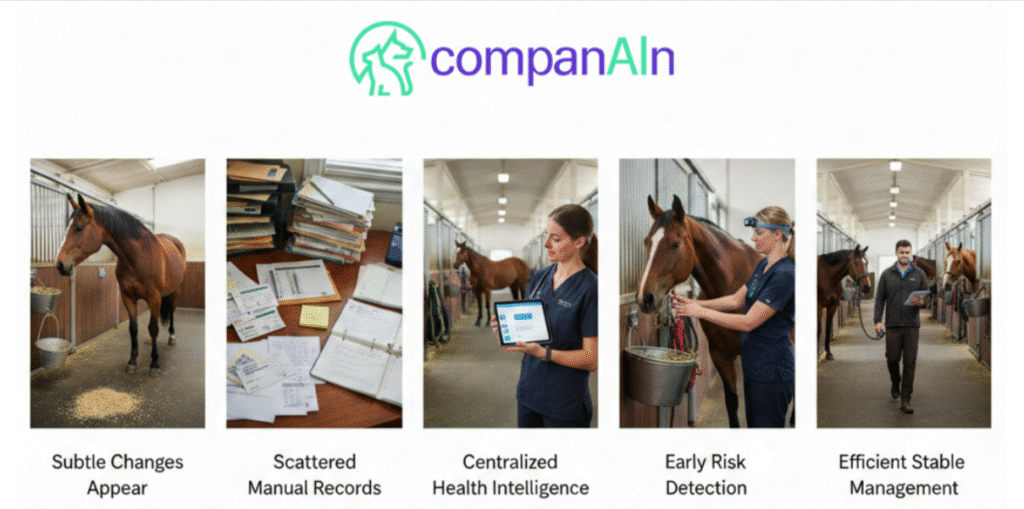
Traditional veterinary record-keeping captures snapshots during examinations but misses the granular behavioral data that reveals developing issues. CompanAIn’s agentic AI technology transforms this fragmented approach into comprehensive health intelligence, analyzing documented observations to detect patterns indicating problems before they escalate.
Why Equine Health Monitoring Needs Intelligence Beyond Databases
Static health databases serve as reference libraries—look up “decreased appetite in horses,” and you’ll find colic gastric ulcers, dental disease, and dozens of other possibilities. What they cannot do is evaluate whether your specific mare’s decreased appetite over two days, given her individual history and current circumstances, requires emergency evaluation tonight or a scheduled examination tomorrow.
Critical factors databases miss:
Individual context matters enormously. A performance horse leaving grain after strenuous competition might have muscle soreness or minor gastric irritation. The same symptom in a pregnant mare in her final trimester could indicate impending colic or metabolic crisis.
Progression velocity determines urgency. Lameness developing suddenly suggests acute injury—abscess, fracture, or ligament damage. Gradual onset over weeks points toward arthritis, laminitis progression, or degenerative joint disease. Intervention timing differs completely.
Baselines are essential. Some horses naturally eat enthusiastically, cleaning every morsel. Others pick selectively, always leaving some grain. Decreased appetite means completely different things for these two horses.
How Agentic AI Analyzes Equine Health
Agentic systems differ fundamentally from simple algorithms through multi-agent architecture. According to veterinary informatics research, multiple specialized AI agents work collaboratively—each handling distinct analytical tasks, sharing insights to generate assessments beyond single-algorithm capability.
Specialized Agents for Equine Analysis
Data Aggregation Agent consolidates information from diverse sources into unified health timelines:
- Veterinary records from lameness exams, dental floats, routine visits
- Daily barn observations—feed consumption, manure output, behavior changes
- Work intensity documentation
- Environmental factors like weather changes, pasture rotations, facility moves
This agent identifies relationships between variables that manual tracking misses. When body condition scoring trends downward despite consistent feeding, CompanAIn’s agent correlates this with dental exam dates, deworming schedules, and workload changes—connections that might take weeks or months to recognize manually.
Health Pattern Recognition Agent compares current observations against individual baselines and population patterns from thousands of similar horses. When you note “seemed stiff getting up,” this agent evaluates whether stiffness represents new behavior or matches the normal morning routine documented over previous months.
The agent incorporates breed-specific disease predispositions:
- Thoroughbreds: Higher gastric ulcer rates, catastrophic musculoskeletal injury risk
- Quarter Horses: Hyperkalemic periodic paralysis, polysaccharide storage myopathy
- Warmbloods: Osteochondritis dissecans susceptibility
Clinical Triage Agent synthesizes inputs from both previous agents, generating specific guidance on urgency and recommended actions. Rather than listing possible conditions, this agent weighs probabilities based on all available context.
Veterinary Oversight Maintains Clinical Standards
Technology handles pattern recognition efficiently, but equine medicine requires professional judgment. When CompanAIn’s agentic AI identifies potentially serious conditions or encounters ambiguous presentations, licensed veterinarians review the analysis before recommendations are provided.
Real-World Applications in Stable Management
Early Colic Detection
Colic remains the leading cause of death in horses; however, early intervention dramatically improves outcomes. According to equine veterinary research, survival rates exceed 95% when simple impaction colics receive treatment within the first hours but drop below 50% for surgical colics presenting after 12+ hours.
The detection challenge: Classic signs—violent rolling, kicking at the abdomen, and profuse sweating—indicate advanced pain. Subtle early indicators include reduced feed consumption, decreased manure output, quiet behavior, and slight changes in gut sounds.
CompanAIn’s technology analyzes documented daily observations for early warning patterns. When feed consumption drops from normal completion to half-finished over 24 hours, manure output decreases from typical eight piles to four, and the horse stands in the back of the stall rather than at the gate—individually minor observations—the system recognizes this cluster as suggesting developing colic.
Critical advantage: Alerts prompt veterinary consultation before severe pain develops, where medical management alone often resolves conditions that would otherwise require surgery.
Lameness Progression Tracking
Subtle lameness proves notoriously difficult to assess consistently. Is your horse slightly more head-bobbing today than last week? It can be hard to say from memory alone.
Systematic documentation reveals trends:
- Behavior during turnout
- Willingness during work
- Head carriage consistency
- Hip hike presence
- Stride length changes
When uploaded videos of trot-ups from multiple dates get analyzed, CompanAIn’s agentic AI identifies whether lameness remains stable, improves, or worsens—providing quantified progression data rather than subjective impressions.
For horses recovering from injuries, postoperative monitoring tracks surgical sites, swelling changes, pain indicators, and return to soundness systematically. When recovery deviates from expected timelines, the system flags deviations for veterinary review.
Metabolic Condition Management
Equine metabolic syndrome and pituitary pars intermedia dysfunction (PPID) require careful long-term management. These conditions develop gradually, with subtle symptom progression that can be easily missed.
Early metabolic syndrome indicators:
- Increased fat deposits (crest, tailhead, sheath)
- Mild laminitis episodes
- Difficulty losing weight despite dietary restriction
PPID presentation includes:
- Delayed shedding
- Increased water consumption
- Muscle wasting
- Laminitis susceptibility
CompanAIn’s Living Health Timeline tracks body condition scores documented monthly, seasonal coat changes photographed for comparison, water consumption logs, and hoof temperature measurements—identifying trends suggesting metabolic dysfunction before acute laminitis crises develop. The platform’s multi-agent system correlates these observations with veterinary exam findings, creating a comprehensive picture of disease progression that guides treatment adjustments.
Reproductive Cycle Optimization
Breeding operations benefit from precise reproductive cycle tracking. Mare behavior changes during estrus—increased urination frequency, tail raising, and receptivity—vary individually. Some mares show obvious heat cycles; others remain subtle.
Systematic documentation of behavioral observations correlated with veterinary reproductive exams creates individualized cycle profiles. When CompanAIn’s agentic system learns a specific mare’s patterns—duration, behavioral indicators, optimal breeding windows—it predicts future cycles and flags deviations suggesting reproductive problems.
AI can further optimize the equine artificial insemination (AI) process by supporting breeders, veterinarians, and stud managers throughout the entire process. Monitoring ovulation using ultrasound is critical to confirm ovulation and time insemination for optimal fertility and pregnancy outcomes. The veterinarian plays a key role in the insemination process, including semen collection from the stallion using an artificial vagina, assessing semen quality and sperm viability, and preparing the mare’s uterus for insemination. Different types of semen—fresh semen, chilled semen, and frozen semen—are used, each requiring specific preservation methods. Frozen semen is stored in liquid nitrogen to maintain viability, and must be thawed precisely before use.
Timing is crucial: insemination should occur prior to ovulation, often requiring monitoring every six hours to ensure the mare ovulates within the optimal window. Hormones may be administered to synchronize cycles and improve success rates. During insemination, a sterile pipette is used to deposit semen through the cervix into the uterus, and proper preparation and technique are essential for success. Challenges such as reduced fertility in older mares, inflammatory reaction, or fluid accumulation in the mare’s uterus must be managed to maximize pregnancy and fertilization outcomes. AI-powered systems like CompanAIn help breeders track every step—from semen collection and preservation, to insemination and pregnancy monitoring—improving herd fertility, supporting stallion selection, and increasing the likelihood of successful impregnation. A comprehensive guide or AI-driven platform streamlines the method, enhances breeder decision-making, and creates better outcomes in equine reproduction.
Multi-Horse Management Efficiency
Single-horse owners track one animal comprehensively. Boarding facilities, breeding operations, and training barns managing dozens of horses face exponentially greater complexity.
Information overload challenges:
- Which horses received recent dental work?
- Who’s due for vaccinations?
- Which animals showed minor lameness requiring monitoring?
CompanAIn’s agentic AI scales effortlessly across multiple animals. Each horse maintains individual health timelines, baselines, and risk profiles. The system generates daily task lists—which horses need monitoring for specific symptoms, upcoming veterinary appointments, medication schedules, and preventive care due dates.
When concerning patterns emerge across multiple horses—several animals developing respiratory symptoms or multiple horses showing signs of sand colic—the technology identifies these facility-wide patterns warranting environmental investigation beyond individual treatment.
Integration With Veterinary Practice
Effective equine AI enhances rather than replaces veterinary relationships. When consultations occur, CompanAIn generates comprehensive summaries that consolidate symptom timelines, environmental factors, treatment responses, and historical patterns into concise reports.
Benefits veterinarians consistently report:
- Improved diagnostic accuracy through detailed historical documentation
- Reduced appointment time spent gathering information
- Precise timeline data showing when symptoms started and how they progressed
- Documented correlating factors like weather changes or exercise intensity
This documentation proves particularly valuable for chronic conditions requiring ongoing management. When monitoring PPID medication effectiveness, documented symptom changes over months reveal whether current dosing adequately controls disease or requires adjustment.
For managing recurrent airway obstruction (heaves), CompanAIn’s pattern recognition correlates respiratory symptom severity with environmental factors—dust exposure, pollen counts, hay quality—guiding treatment optimization that would be nearly impossible to track manually across months or years.
Privacy and Data Security
High-value sport horses, breeding stock, and competition animals represent significant financial investments. Health information about these animals holds commercial value—sale prospects, competition eligibility, and breeding desirability all depend partly on health status.
Robust data security protects sensitive equine health information from unauthorized access. Veterinary-grade encryption standards ensure health records remain accessible only to authorized users, maintaining confidentiality around injuries affecting competition eligibility or health conditions impacting sale value.
The Future of Equine Health Intelligence
Current agentic AI applications focus on pattern recognition within documented data. Future developments will incorporate sensor integration:
- Automatic feed intake monitoring through RFID-tagged buckets
- Pasture movement tracking via GPS
- Vital sign monitoring through wearable devices
- Video-based gait analysis identifying subtle lameness
These technologies will enable continuous automated data collection, supplementing human observations with objective measurements. Combined with advancing AI analytical capabilities, equine health monitoring will shift from reactive problem management to proactive prevention—identifying developing conditions before they manifest obvious symptoms.
Transform Your Stable's Health Monitoring Today
Every hour matters when subtle behavioral changes signal developing colic. Every training session counts when tracking recovery from lameness. Every observation provides critical context when managing metabolic conditions over years.
CompanAIn’s agentic AI platform brings intelligent pattern recognition to equine care, transforming scattered observations into comprehensive health intelligence. Whether you manage a single performance horse or oversee dozens of animals across breeding and training operations, the technology scales to your needs—organizing documentation, flagging concerning trends, and enabling earlier veterinary intervention when treatment is most effective.
Ready to move beyond reactive crisis management? Explore how CompanAIn’s Living Memory technology creates continuously evolving health roadmaps for your horses, catching problems before they steal performance, compromise breeding value, or threaten life. When prevention matters more than reaction, intelligent monitoring makes all the difference.
Contact CompanAIn today to discover how multi-agent AI transforms equine health management from crisis response to proactive wellness.
How does equine AI differ from standard veterinary record systems?
Traditional veterinary software stores snapshots from examinations—diagnoses, treatments, lab results. Equine AI analyzes continuous daily observations between veterinary visits, identifying patterns in behavior, appetite, soundness, and other indicators that reveal developing problems. The agentic technology correlates these patterns with breed risks, individual baselines, and environmental factors, generating actionable insights rather than just storing static records.
Can AI detect colic before obvious symptoms appear?
AI cannot predict colic occurrence, but agentic systems identify early warning patterns—decreased feed consumption, reduced manure output, quiet behavior, subtle pain indicators—that suggest developing colic before severe distress manifests. Research shows early intervention dramatically improves colic outcomes. Pattern recognition allows these subtle changes to trigger alerts prompting veterinary evaluation while conditions remain treatable with medical management.
Is this technology practical for small farms with just a few horses?
Yes. While larger operations benefit from managing multiple horses efficiently, small farms gain value through comprehensive individual horse monitoring. Detailed health timelines improve veterinary communication, early problem detection prevents minor issues from becoming emergencies, and systematic tracking ensures preventive care stays current. The technology scales appropriately whether managing one horse or fifty.
What happens to the data if I sell a horse?
Health records can be transferred to new owners if authorized, providing a comprehensive medical history that benefits ongoing care. This complete documentation adds value during sales by demonstrating professional health management. Alternatively, records can be permanently deleted or retained in your account for reference while blocking access from others, depending on your preferences and sale agreements.
Does this replace regular veterinary care?
No. Equine AI enhances veterinary relationships by improving communication quality and enabling earlier intervention. The technology identifies concerning patterns warranting professional evaluation but cannot diagnose conditions or replace physical examination. Veterinarians make diagnostic and treatment decisions; AI provides data-driven insights informing those decisions through comprehensive health documentation and pattern recognition capabilities unavailable through manual record-keeping.