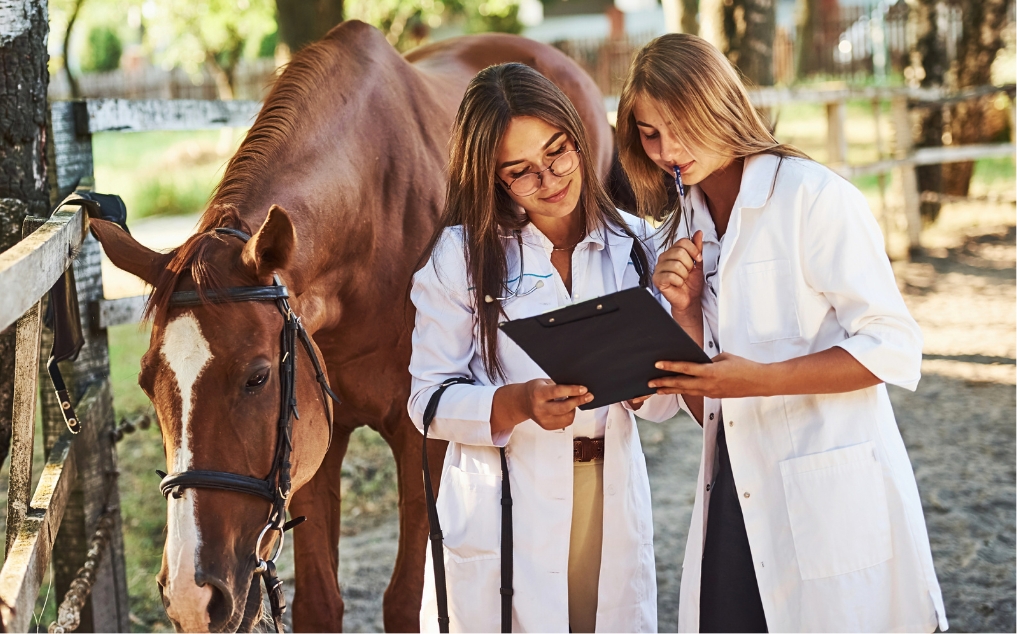

Stride length shortening by three centimeters. Heart rate recovery taking 45 seconds longer post-workout than baseline. Muscle enzyme elevation of 12% on recent bloodwork. Individually, these metrics fall within normal ranges. Combined and tracked over six weeks, they reveal declining performance capacity that traditional monitoring misses until competition results suffer or lameness develops.
Performance horses operate at physiological limits where marginal changes determine competitive success or injury risk. Event horses, racehorses, show jumpers, and dressage athletes require monitoring precision that surpasses standard wellness care. Yet most performance tracking relies on subjective trainer observations, periodic veterinary exams, and owner intuition—approaches that struggle to quantify subtle deterioration occurring between obviously healthy and obviously injured states.
Equine diagnostics traditionally focus on identifying existing problems. CompanAIn’s agentic AI technology shifts this paradigm toward predictive performance optimization, analyzing multiple physiological and behavioral variables simultaneously to detect declining trends before they manifest as clinical problems or competitive failures.
The Limitations of Traditional Performance Assessment
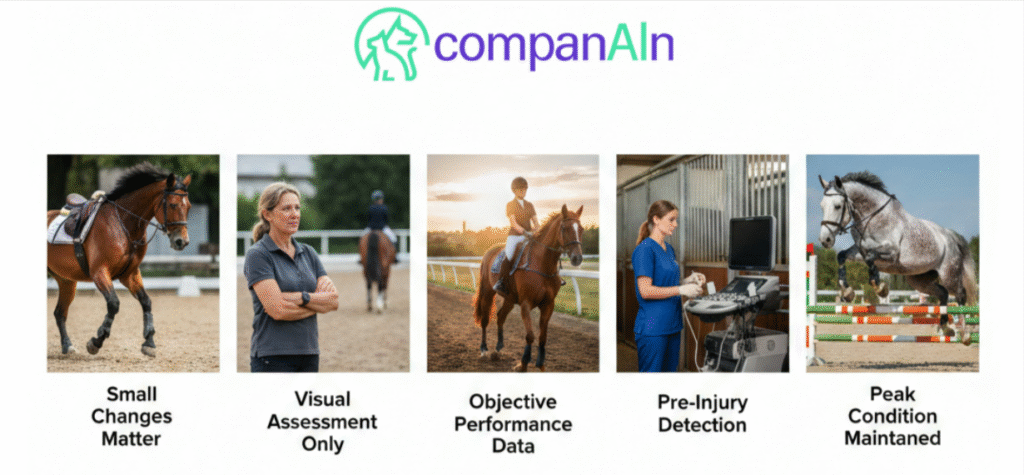
Trainers evaluate horses daily through visual assessment—does the horse look sound, appear energetic, move willingly? These observations provide valuable information but lack quantification. “Seemed a bit off today” offers no measurable data for tracking trends or comparing to previous weeks.
Periodic veterinary examinations capture snapshots. Lameness evaluations, flexion tests, and palpation identify current issues, but they don’t reveal progressive changes developing between visits. A horse showing Grade 1 lameness at exam might have been completely sound three weeks prior—potentially critical information for determining whether the problem is acute injury or gradual deterioration.
Performance metrics like race times, jump heights, or dressage scores reflect the cumulative result of training, fitness, and health status but don’t identify which specific factors drive performance changes. Slower race times could stem from inadequate conditioning, developing musculoskeletal injury, respiratory compromise, metabolic dysfunction, or suboptimal nutrition. Without granular data, determining root causes requires guesswork.
How Multi-Agent Systems Transform Performance Monitoring
According to research in equine sports medicine, elite athletic performance depends on complex interactions between cardiovascular fitness, musculoskeletal soundness, respiratory capacity, metabolic efficiency, and mental state. Optimizing performance requires monitoring all these domains simultaneously and identifying how they influence each other.
The Three-Agent Architecture for Performance Analysis
CompanAIn’s agentic technology consolidates physiological data from multiple sources into unified performance profiles. This includes:
- Heart rate variability during work and recovery periods
- Stride characteristics from motion capture or GPS tracking
- Respiratory rate patterns under varying exercise intensities
- Body temperature regulation during and after exertion
- Blood biomarkers from routine screening (muscle enzymes, electrolytes, inflammatory markers)
Rather than treating these as independent measurements, CompanAIn’s platform identifies correlations. Rising muscle enzyme levels paired with decreased stride length and slower heart rate recovery collectively suggest a developing muscle pathology that none of the metrics would flag individually.
The system tracks metrics longitudinally, establishing individual baselines and detecting deviations. Not all horses demonstrate identical “normal” values—some naturally have higher resting heart rates, while others show different stride patterns based on conformation.
When stride length decreases by 5% over four weeks, the platform evaluates whether this change exceeds normal variation or represents meaningful deterioration. Context matters—stride shortening during a planned deconditioning period differs from unexplained stride changes during peak training.
According to equine exercise physiology research, certain metric combinations reliably predict impending breakdown. Gradual increases in asymmetry measurements, declining recovery rates, and persistent mild elevations in inflammatory markers collectively indicate heightened injury risk even before lameness appears.
The system generates alerts when metric combinations suggest performance declining or injury risk increasing, enabling intervention before catastrophic failure occurs.
Real-World Applications Across Disciplines
Racehorse Fitness Optimization
Thoroughbred and Standardbred racing demands precise fitness management. Horses must peak at specific dates—training them too conservatively leaves fitness undertapped, while excessive work causes breakdown.
Key metrics agentic AI tracks for racehorses:
- Speed at standardized heart rates (measuring cardiovascular fitness)
- Recovery heart rate after gallops (indicating aerobic capacity)
- Stride frequency and length consistency (revealing biomechanical efficiency)
- Body weight fluctuations (monitoring muscle mass versus fat)
- Complete blood counts showing red blood cell production and oxygen-carrying capacity
CompanAIn’s Living Health Timeline consolidates these measurements from training sessions over months, comparing current fitness markers against the horse’s previous peak performance periods. When metrics indicate fitness approaching or declining from optimal levels, training intensity adjusts accordingly.
Racehorse trainers report this data-driven approach reduces training-related injuries by identifying horses requiring modified workloads before stress fractures or soft tissue injuries develop.
Eventing and Endurance Performance
Three-day eventing and endurance racing test horses across multiple days or extended distances. Managing hydration, electrolyte balance, and metabolic efficiency becomes as critical as conditioning.
Metabolic monitoring reveals hidden problems:
Horses can appear clinically sound while developing subclinical metabolic imbalances that compromise performance or predispose them to synchronous diaphragmatic flutter (thumps), exhausted horse syndrome, or colic.
Integration With Veterinary Diagnostics
Performance monitoring data enhances veterinary diagnostic accuracy when problems develop. Rather than examining horses at a single point in time, veterinarians review comprehensive performance timelines showing how the current presentation developed.
A horse presenting with mild hind limb lameness receives a more accurate diagnosis when veterinarians review:
- Stride analysis showing gradual shortening over six weeks (suggesting chronic issue)
- Training logs revealing increased jump height coinciding with symptom onset (suggesting overuse injury)
- Previous flexibility assessments showing progressive restriction in hock range of motion (localizing problem)
According to veterinary orthopedic specialists, this contextual information frequently changes diagnostic and treatment approaches compared to evaluation based solely on current examination findings. CompanAIn organizes this longitudinal data automatically, presenting veterinarians with complete performance histories that would take hours to compile manually.
Optimizing Diagnostic Testing Timing
Expensive diagnostic imaging—radiographs, ultrasound, MRI, scintigraphy—provides valuable information but represents significant cost. Performing advanced diagnostics on every horse showing minor performance decline proves economically impractical for most operations.
CompanAIn’s agentic technology helps determine when advanced diagnostics become warranted versus when conservative management and continued monitoring suffice. Horses showing concerning metric combinations—progressive asymmetry, persistent post-exercise inflammation markers, declining performance despite adequate training—receive diagnostic imaging sooner. Horses with stable metrics suggesting minor, self-limiting issues avoid unnecessary testing expense.
This risk stratification ensures diagnostic resources get allocated to horses most likely to benefit while avoiding both over-testing low-risk horses and under-testing high-risk athletes.
Return-to-Work Protocols After Injury
Managing horses recovering from injury requires balancing adequate healing time against deconditioning and prolonged absence from competition. Return too quickly, and reinjury occurs. Progress too conservatively, and fitness deteriorates unnecessarily.
Agentic AI tracks recovery metrics specific to injury type:
Soft tissue injuries (tendon and ligament strains) require monitoring:
- Ultrasound fiber pattern improvements
- Heat and swelling measurements
- Stride symmetry returning to pre-injury baseline
- Heart rate responses to controlled exercise remaining appropriate for workload
Bone injuries (stress fractures, osteoarthritis) require tracking:
- Radiographic healing progression
- Pain responses to increasing load
- Biomechanical compensation patterns normalizing
- Inflammation markers returning to baseline
The system generates individualized return-to-work schedules based on how recovery metrics compare to expected healing timelines. Horses progressing faster than typical receive accelerated protocols. Those showing delayed healing continue modified work longer, preventing premature return that risks catastrophic reinjury.
Multi-Horse Comparison for Training Optimization
Training facilities managing multiple athletes benefit from comparative analysis across their string. Are certain training protocols producing better fitness outcomes? Do specific warm-up routines correlate with reduced injury rates? Does recovery time between hard workouts affect subsequent performance?
Agentic technology analyzes performance data across multiple horses simultaneously, identifying training approaches that minimize injury risk. This population-level analysis reveals patterns invisible when examining individual horses in isolation.
For example, analysis might show horses receiving dynamic warm-ups demonstrate 8% better stride symmetry and 15% faster heart rate recovery compared to horses receiving static stretching only. This evidence-based insight allows trainers to modify protocols barn-wide, improving outcomes systematically.
Addressing Data Overload
Comprehensive monitoring generates substantial data volume—hundreds of measurements per horse weekly. Human analysis of this information proves impractical; critical patterns get lost in noise.
AI excels at this precise challenge—processing large datasets to identify meaningful signals. CompanAIn’s technology doesn’t replace trainer expertise; it augments human observation with computational pattern recognition that catches subtle changes invisible to visual assessment alone.
Trainers receive synthesized summaries highlighting actionable insights rather than raw data dumps requiring interpretation. “Stride length decreased 4% over 3 weeks, heart rate recovery 12% slower—recommend reducing training intensity 20% next week” provides clear guidance based on comprehensive data analysis.
The Competitive Advantage
Elite equine athletics increasingly separate winners from competitors by marginal performance differences. Horses finishing races separated by hundredths of seconds, show jumping courses decided by a single rail, and dressage scores differing by fractions of percentage points.
Systematic performance monitoring through agentic AI provides competitive advantages through:
- Earlier injury detection preventing catastrophic breakdowns that end careers
- Fitness optimization ensuring horses peak at target competitions
- Individualized training protocols based on each horse’s response patterns
- Reduced training-related injuries extending competitive careers
- Data-driven decisions replacing guesswork in conditioning programs
Operations implementing comprehensive performance monitoring report measurable improvements in competition results alongside reduced injury rates—the dual goal of maximizing athletic achievement while protecting horse welfare.
Transform Your Performance Program Today
The difference between championship and disappointment is often measured in fractions—tenths of seconds, single obstacles, decimal points in scoring. CompanAIn’s multi-agent AI platform transforms how performance horses train, compete, and recover, catching problems when intervention prevents career-ending injuries rather than merely managing damage after it occurs.
Whether you’re conditioning racehorses for peak speed, managing eventers through multi-day competitions, or refining show jumpers and dressage athletes for technical precision, intelligent monitoring provides the competitive edge that marginal gains demand.
Explore how CompanAIn’s Living Memory technology creates continuously evolving performance profiles that guide training decisions, optimize veterinary interventions, and extend athletic careers. When milliseconds matter and soundness determines everything, data-driven performance management isn’t optional—it’s essential.
Frequently Asked Questions
How does equine AI improve diagnostic accuracy?
Agentic AI provides veterinarians with comprehensive performance timelines showing how current problems developed over weeks or months. This longitudinal data reveals whether lameness represents acute injury or gradual deterioration, identifies which training activities correlate with symptom onset, and shows how multiple physiological systems (cardiovascular, musculoskeletal, metabolic) interact to affect performance. According to equine sports medicine research, this contextual information frequently changes diagnostic approaches compared to examinations based solely on single-point-in-time findings.
What metrics are most important for performance monitoring?
Critical metrics vary by discipline. Racehorses require cardiovascular fitness indicators (heart rate recovery, speed at standardized heart rates) and stride biomechanics. Eventers need metabolic markers (hydration, electrolyte balance) and sustained work capacity. Show jumpers and dressage horses benefit from biomechanical precision measurements (joint angles, symmetry, flexibility). Comprehensive monitoring tracks multiple domains simultaneously since elite performance depends on all systems functioning optimally together.
Can this technology prevent catastrophic injuries?
Complete prevention proves impossible, but agentic AI significantly reduces catastrophic injury rates by detecting early warning signs. Research shows certain metric combinations—progressive stride asymmetry, elevated inflammatory markers, declining recovery rates—reliably predict impending breakdown. Intervention when these patterns emerge often prevents minor issues from progressing to career-ending injuries. Equine facilities using comprehensive monitoring report 40-60% reductions in training-related serious injuries.
Is performance monitoring practical for amateur competitors?
Yes. While professional operations manage larger data volumes across multiple horses, amateur competitors benefit from optimizing their individual horse’s conditioning and injury prevention. Basic monitoring requires minimal equipment—heart rate monitors, smartphone video for stride analysis, routine veterinary bloodwork. The technology scales appropriately whether managing one horse or fifty, providing individualized insights that improve training effectiveness and welfare regardless of competition level.
How does this integrate with existing veterinary relationships?
Performance monitoring enhances rather than replaces veterinary care. The technology identifies when horses require professional evaluation and provides veterinarians with comprehensive data, improving diagnostic accuracy. Veterinarians make treatment decisions; AI provides performance intelligence informing those decisions. Most equine veterinarians welcome detailed performance data, as it improves their ability to diagnose problems early and monitor treatment effectiveness objectively rather than relying solely on subjective trainer reports.