
Figuring out how much milk thistle for dogs means navigating more than simple weight calculations. Liver enzyme patterns matter. So do concurrent medications, breed tendencies, and whether you’re managing chronic disease or providing general support.
Supplement bottles offer little clarity. Labels list ranges spanning 50 to 500 milligrams depending on body weight, but silymarin content varies wildly between products. Some measure active compound concentration, others report whole herb equivalents. Without context, you’re guessing whether that 150-milligram capsule delivers therapeutic benefit or falls short.
CompanAIn changes this equation entirely. Upload recent bloodwork, veterinary notes, and your dog’s medication list. The platform’s specialized AI agents evaluate liver enzyme trends, flag potential drug interactions, and generate dosing recommendations matched to your dog’s specific health profile—not generic weight brackets.
Understanding Milk Thistle's Role in Canine Liver Function
Milk thistle contains silymarin, extracted from the plant’s seeds. This flavonoid complex concentrates in liver cells once absorbed, performing several distinct protective functions.
Silymarin strengthens cell membranes against toxic damage. When toxins attack liver cells, they disrupt membrane integrity, allowing cellular contents to leak and triggering inflammation. Research published in pharmacology journals confirms silymarin reinforces these membranes, increasing resistance to assault.
The compound also neutralizes free radicals. Liver processing generates unstable molecules that damage DNA and accelerate aging. Silymarin stops these free radicals before harm occurs.
Additionally, it promotes protein synthesis. Damaged tissue needs regeneration, and silymarin enhances the liver’s capacity to produce new proteins that support repair and recovery.
Research published in Veterinary Medicine International demonstrates silymarin’s effectiveness in dogs with liver disease, showing improved enzyme normalization when combined with standard treatment. The supplement enhances medical intervention rather than replacing it.
Why Standard Weight Charts Miss Critical Variables
Generic dosing charts ignore factors that determine whether milk thistle helps, does nothing, or potentially causes issues.
Liver enzyme patterns drive dosing decisions. A dog with mildly elevated ALT from temporary stress needs different support than one with persistently high alkaline phosphatase indicating bile duct problems. Acute toxin exposure requires higher doses than general maintenance.
Medications create interaction risks. According to research in Drug Metabolism and Disposition, milk thistle affects cytochrome P450 enzymes responsible for metabolizing many drugs. While human studies show minimal clinical interactions, dogs taking certain medications may experience altered drug effectiveness.
Breed sensitivities introduce complications. Bedlington Terriers develop copper storage disease, requiring chelation therapy alongside milk thistle. Doberman Pinschers face immune-mediated hepatitis needing immunosuppressive treatment. Generic formulas can’t account for these genetic predispositions.
Product formulations vary dramatically. Standardized extracts containing 80% silymarin deliver different potency than whole herb powders. Without formulation context, accurate dosing becomes impossible.
CompanAIn’s multi-agent system analyzes your dog’s complete health timeline, calculating doses that reflect metabolic individuality and medical history rather than body weight alone.
AI-Powered Dosage Calculation: How CompanAIn Works
Traditional calculators request weight and output a number. CompanAIn’s approach functions fundamentally differently.
The Data Aggregator compiles medical records—lab results showing enzyme trends, medications that might interact, documented adverse reactions. The Health Analyzer evaluates patterns against extensive canine liver disease databases, identifying whether enzyme elevations are progressing or stabilizing.
The Recommendation Engine generates specific guidance: optimal silymarin content based on disease severity, dosing frequency matched to metabolic profile, and potential medication conflicts.
The system considers supplement bioavailability. Milk thistle absorbs better with fatty meals. If your dog eats low-fat prescription food, the platform may suggest higher doses to compensate. If multiple daily medications are involved, it might recommend timing strategies to minimize interactions.
This isn’t weight-based guesswork—it’s analysis grounded in individual physiology and medical context.
Therapeutic Dose Ranges: Matching Purpose to Amount
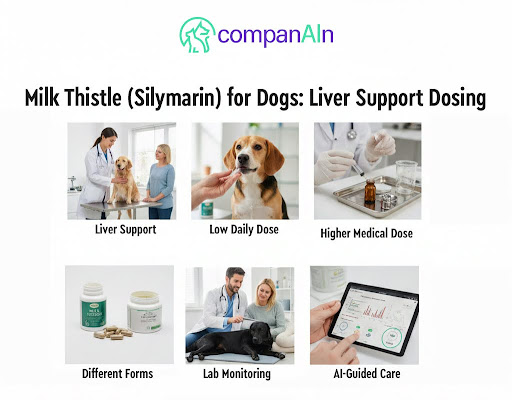
Different liver situations require different approaches. According to veterinary dosing guidelines, therapeutic ranges for silymarin typically span 5-20 mg per kilogram of body weight daily.
General hepatic support (5-10 mg/kg daily): Appropriate for dogs on medications that stress liver function—NSAIDs, certain antibiotics, seizure drugs. Provides antioxidant support without therapeutic intervention.
Mild enzyme elevation (10-15 mg/kg daily): Suitable when bloodwork shows slight ALT or AST increases without clinical symptoms. Supports cellular repair during diagnostic investigation.
Active liver disease treatment (15-20 mg/kg daily): Reserved for diagnosed hepatopathy with significant enzyme elevations or imaging evidence of damage. Provides therapeutic silymarin concentrations.
Acute toxin exposure (higher doses under veterinary supervision): Applied when dogs ingest hepatotoxins. Requires emergency veterinary involvement alongside supplementation.
CompanAIn’s personalized recommendations specify amounts and therapeutic goals, clarifying what you’re trying to accomplish and whether the strategy matches your dog’s situation.
Monitoring Response Through Objective Metrics
Supplementing without tracking results leaves you guessing. Several markers reveal effectiveness.
Liver enzyme trends provide data. If ALT drops from 400 U/L to 200 U/L over eight weeks, you’re seeing measurable improvement. According to veterinary liver enzyme guides, stable or rising enzymes suggest adjustments are needed.
Clinical signs offer context. Dogs with liver disease often show decreased appetite, intermittent vomiting, reduced activity. Improvement suggests function is recovering, though clinical improvement without enzyme monitoring can mislead.
Bile acid testing reveals capacity. Fasting and postprandial bile acid measurements assess how effectively the liver processes these compounds. Normal values indicate good function regardless of enzyme levels.
CompanAIn’s Living Memory technology tracks these metrics over time. Upload new bloodwork every few months, and the platform charts trends, flags unexpected changes, and adjusts recommendations based on response patterns.
Product Formulations: Why Standardization Matters
Walk into any pet store and you’ll find dozens of milk thistle products offering vastly different values.
Standardized extracts specify silymarin content. Labels reading “milk thistle extract standardized to 80% silymarin” guarantee precise active compound amounts. A 250-milligram capsule delivers 200 milligrams of silymarin—the substance benefiting liver cells.
Whole herb powders offer unpredictability. Products labeled “milk thistle seed powder 500 mg” contain naturally occurring silymarin around 1.5-3%. That 500-milligram capsule might deliver only 7.5-15 milligrams of silymarin—roughly one-tenth the standardized extract potency.
Enhanced-absorption formulations use technology. Some manufacturers incorporate phospholipid complexes (silibinin-phosphatidylcholine) or combine milk thistle with piperine to boost absorption. These may deliver greater benefits at lower doses.
CompanAIn accounts for product type. Using whole herb powder? The platform calculates higher quantities to compensate. Using enhanced formulations? It adjusts downward appropriately.
Key Formulation Differences
- 80% standardized extract: Highest silymarin concentration per milligram
- Whole herb powder: 5x more volume needed for equivalent silymarin
- Phospholipid complex: Enhanced bioavailability, lower doses required
- Liquid tinctures: Precise dosing for small dogs, absorption varies by extraction method
Integration with Existing Treatments
Milk thistle rarely stands alone. Most dogs receive multiple interventions simultaneously—medications, dietary changes, other supplements.
SAMe complements milk thistle. While silymarin protects cells, SAMe supports glutathione production—the liver’s primary antioxidant. Combined, they address different hepatic health aspects. CompanAIn evaluates whether you’re using both and coordinates dosing.
Ursodiol serves different purposes. Veterinarians prescribe this bile acid for cholestatic diseases where bile flow is impaired. Milk thistle supports cellular repair during improved flow but doesn’t replace ursodiol’s mechanism.
Dietary management influences effectiveness. Low-fat diets reduce absorption. High-protein diets support regeneration but increase nitrogen processing. CompanAIn factors dietary information into calculations.
Medication timing requires coordination. Dogs taking drugs metabolized through liver enzymes need careful spacing. The platform identifies interactions and suggests timing strategies.
Breed-Specific Considerations
Not all dogs process supplements identically. Genetic predispositions influence dosing and monitoring approaches.
Bedlington Terriers: According to research on copper storage disease, these dogs accumulate excessive hepatic copper. Milk thistle supports cellular health but doesn’t address accumulation. They need chelation therapy alongside supplementation.
Doberman Pinschers: This breed develops immune-mediated liver inflammation more frequently. Milk thistle provides antioxidant support but doesn’t suppress aberrant immune responses requiring immunosuppressive therapy.
Labrador Retrievers: Labs’ efficient metabolisms may influence absorption and processing. They might require slightly higher per-kilogram doses compared to less active breeds.
Small breeds: Toy and miniature breeds often need proportionally higher per-kilogram doses due to faster metabolic rates. A five-pound Chihuahua doesn’t receive one-tenth the dose of a fifty-pound Labrador—scaling isn’t linear.
CompanAIn's Adaptive Approach
Static protocols assume needs remain constant. They don’t. Liver disease evolves—improving with treatment or progressing despite intervention.
CompanAIn’s Living Memory tracks response over time. Upload bloodwork from months ago, then again today. The platform identifies whether trends move favorably, hold steady, or worsen, using trajectory to refine recommendations.
If ALT drops significantly, the system might suggest gradually reducing to maintenance levels. If enzymes plateau despite supplementation, it might recommend increasing slightly or adding interventions.
The multi-agent system learns from patterns across thousands of similar cases. Dogs with comparable breed, age, disease type, and enzyme patterns provide data informing recommendations for your pet.
Licensed DVMs review complex cases and low-confidence recommendations, ensuring guidance aligns with veterinary standards. You’re getting AI-enhanced analysis validated by professionals who understand liver disease.
When Veterinary Consultation Becomes Essential
CompanAIn provides sophisticated guidance but doesn’t replace veterinary judgment in certain situations.
Acute symptoms require immediate attention. Sudden jaundice, vomiting blood, or unresponsiveness demands emergency care. Milk thistle supports liver health but can’t reverse acute failure.
Unexplained elevations need investigation. AI optimizes dosing based on existing data but can’t diagnose why enzymes elevated initially. Veterinary workup—imaging, additional testing, possibly biopsy—must occur.
Lack of improvement signals problems. Following recommendations consistently for two to three months without bloodwork improvement means something beyond milk thistle’s capabilities is occurring.
Complex medication regimens need professional coordination. Dogs on multiple liver-metabolized drugs require careful management. While CompanAIn identifies interactions, your veterinarian must ultimately coordinate dosing and monitor effects.
The platform’s DVM review system identifies these situations and explicitly recommends veterinary consultation when AI support alone proves insufficient.
Ready to Stop Guessing About Milk Thistle Dosages?
Determining how much milk thistle for dogs involves complexity that weight-based charts can’t address. Liver enzyme patterns, concurrent medications, breed factors, formulations, and metabolic variations all influence optimal dosing.
CompanAIn’s multi-agent AI system analyzes these variables thoroughly. The platform reviews your dog’s complete health timeline, evaluates treatments, identifies interactions, and generates personalized recommendations that evolve as conditions change.
This isn’t generic advice applied broadly—it’s precision guidance calibrated to your dog’s medical reality. The Living Memory technology ensures recommendations improve over time as data accumulates, creating increasingly accurate support strategies.
Licensed veterinarians validate recommendations, ensuring platform guidance aligns with professional standards. You’re receiving AI-enhanced analysis backed by actual veterinary oversight, not algorithmic suggestions without supervision.
When managing canine liver disease, guesswork wastes time and potentially misses early intervention opportunities. CompanAIn eliminates uncertainty, providing confident, data-driven dosing guidance that supports hepatic health effectively.
Explore CompanAIn’s AI-powered platform today and discover how personalized analysis transforms supplement management from guesswork into informed care.
Frequently Asked Questions
How much milk thistle should I give my dog?
According to veterinary research on milk thistle usage, therapeutic doses typically range from 5-20 mg of silymarin per kilogram of body weight daily, depending on disease severity and concurrent treatments. CompanAIn analyzes your dog’s specific health data rather than relying on generic charts.
Can milk thistle reverse liver damage in dogs?
Milk thistle supports hepatic cell protection and regeneration but can’t reverse severe cirrhosis or advanced failure. According to VCA Animal Hospitals, it works best when started early alongside veterinary treatment, helping prevent progression rather than curing established damage.
Are there side effects of milk thistle in dogs?
Most dogs tolerate milk thistle well. Occasional mild digestive upset—loose stools or temporary nausea—occurs in some animals, typically at higher doses. These effects usually resolve with dose reduction.
How long does milk thistle take to improve liver enzymes?
Noticeable enzyme improvements typically appear within 4-8 weeks of consistent supplementation at appropriate therapeutic doses. Some dogs show changes sooner, others require 12 weeks. CompanAIn tracks these timelines and adjusts recommendations based on response.
Can I use human milk thistle supplements for my dog?
Yes. Human-grade standardized extracts work equally well and often cost less than veterinary products. Ensure you’re calculating doses based on silymarin content and choose products without xylitol, which is toxic to dogs.
Does milk thistle interact with my dog’s medications?
Milk thistle can affect liver enzymes that metabolize certain drugs. While research shows minimal clinical interactions in humans, CompanAIn’s platform identifies these potential interactions and recommends dosing strategies that minimize interference with critical treatments.