
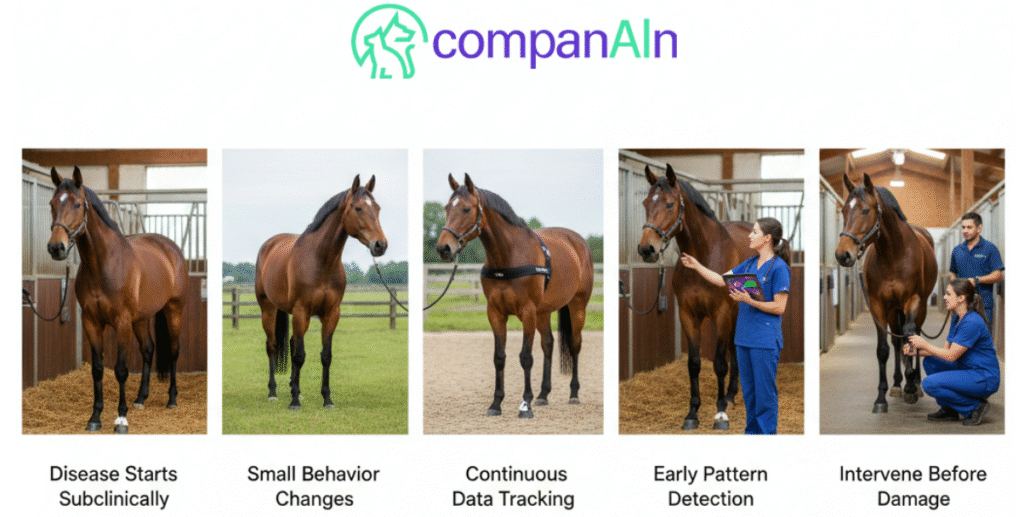
Subclinical laminitis developing before digital pulses strengthen. Gastric ulceration progressing while appetite remains normal. Degenerative joint disease advancing months before obvious lameness appears. The gap between disease initiation and clinical detection represents veterinary medicine’s greatest challenge—by the time symptoms become apparent, pathology has often progressed beyond optimal treatment windows.
Traditional diagnostic approaches react to observable signs. When horses present with symptoms, veterinarians perform examinations and testing, diagnoses get made, and treatment begins. This model works for acute injuries and obvious illnesses but fails for insidious conditions developing gradually over weeks or months.
CompanAIn’s agentic AI technology addresses this gap by continuously analyzing behavioral observations, physiological measurements, and environmental factors—identifying disease-indicative patterns before clinical signs manifest.
How AI Agents Enable Continuous Disease Surveillance
Agentic AI differs from periodic veterinary assessment through constant monitoring. Rather than examining horses at intervals, CompanAIn’s technology analyzes documented observations daily, comparing current data against individual baselines and population disease patterns.
Multi-Domain Data Integration
Behavioral monitoring tracks subtle activity changes indicating discomfort or illness before obvious symptoms develop:
- Feed consumption patterns (quantity, speed, selectivity)
- Movement frequency during turnout
- Social interaction changes (herd position, proximity to others)
- Rest patterns (lying down frequency and duration)
- Response to routine handling
According to equine behavior research, horses experiencing pain or illness show subtle but measurable behavioral changes days before clinical signs become apparent to human observers. Decreased movement, social withdrawal, and altered rest patterns precede obvious lameness or colic symptoms.
Physiological data processing reveals internal dysfunction:
- Body weight trends (detecting gradual loss invisible day-to-day)
- Body temperature patterns (identifying subtle fever or hypothermia)
- Heart rate variability (indicating stress, pain, or cardiovascular changes)
- Respiratory rate at rest (showing developing respiratory compromise)
- Digital pulse strength and symmetry (early laminitis indicator)
Environmental context correlates health changes with external factors that influence disease risk:
- Weather patterns (temperature, humidity, barometric pressure changes)
- Pasture conditions (grass sugar content, toxic plant exposure)
- Facility modifications (new bedding, different hay source)
- Social disruptions (new horses, changed housing)
- Management changes (altered feeding schedules, different caretakers)
This correlation identifies when health changes coincide with environmental shifts, distinguishing stress-related temporary changes from true disease processes requiring intervention.
Disease-Specific Early Detection Applications
Laminitis Before Structural Damage
Laminitis represents one of the most devastating equine conditions, yet intervention during preclinical stages dramatically improves outcomes. Research shows biochemical and vascular changes precede laminar separation by 24-72 hours.
Early warning indicators agentic technology can detect:
- Increased digital pulse strength in multiple feet
- Subtle weight-shifting behavior during standing
- Decreased voluntary movement during turnout
- Mild reluctance moving on hard surfaces
- Slight increases in resting respiratory rate (pain indicator)
Individually, these observations seem unremarkable. Collectively within 24-48 hours, they form a pattern strongly suggesting developing laminitis. CompanAIn’s Living Health Timeline tracks these observations, documenting patterns that enable veterinarians to intervene aggressively—icing, anti-inflammatory medication, dietary modification—before structural hoof damage occurs.
Gastric Ulcers During Asymptomatic Stages
Up to 90% of performance horses develop gastric ulceration according to equine internal medicine research, yet many remain asymptomatic until ulcers become severe. Even when ulcers don’t produce obvious symptoms, they can still impair performance and increase colic risk.
Subtle indicators preceding obvious symptoms:
- Slight decrease in feed enthusiasm (eating slower, leaving small amounts)
- Minor changes in attitude (less eager during grooming or tacking)
- Occasional mild discomfort expressions (ear pinning when girthing)
- Decreased performance (working less enthusiastically without obvious physical cause)
- Intermittent loose manure
CompanAIn’s multi-agent system analyzes these observations alongside risk factors—intense training schedules, NSAID use, transport stress—building comprehensive profiles that help veterinarians determine when gastroscopy or empirical treatment becomes warranted, catching ulcers before they progress to severe stages causing weight loss, colic, or performance failure.
Osteoarthritis Before Radiographic Changes
Degenerative joint disease begins with biochemical cartilage degradation, often months or years before visible structural changes appear. Early intervention with joint therapy, modified work, and anti-inflammatory protocols slows progression dramatically compared to treatment beginning after significant damage appears on radiographs.
Pre-clinical osteoarthritis indicators:
- Subtle stiffness after rest periods (working out of it within minutes)
- Mild reluctance performing movements stressing specific joints
- Slight filling or warmth in joints after work
- Decreased stride length in affected limbs (detectable through motion analysis)
- Increased time lying down or shifting weight when standing
CompanAIn’s technology tracks these observations, identifying progressive patterns. A horse showing occasional post-work joint filling that increases in frequency over months, paired with gradually shortening stride length and increased rest periods, demonstrates a concerning trajectory. Early veterinary evaluation enables intervention before irreversible joint damage occurs.
Integrating Laboratory Diagnostics With AI Analysis
Routine bloodwork provides valuable health information but typically gets interpreted at single points in time. Results falling within normal ranges receive little attention even when they’ve shifted significantly from previous values.
Trend analysis reveals hidden problems: A horse maintaining total protein at 7.2 g/dL for years who now measures 6.8 g/dL remains within normal range (6.0-8.0 g/dL). But the individual decline might indicate developing protein loss through kidney disease, intestinal parasitism, or other conditions.
CompanAIn’s agentic AI tracks laboratory values longitudinally, identifying statistically significant trends even when individual results remain within population norms. This individual baseline comparison catches developing problems missed by standard result interpretation.
Key laboratory trends indicating emerging disease:
- Gradually rising muscle enzymes (subclinical myopathy developing)
- Declining red blood cell indices (chronic blood loss or poor production)
- Increasing inflammatory markers (ongoing disease process)
- Shifting electrolyte patterns (renal or endocrine dysfunction)
- Changing liver enzyme ratios (hepatic disease progression)
When laboratory trends correlate with behavioral or physiological changes—rising muscle enzymes paired with decreased performance and increased rest, for example—the combined pattern strength increases dramatically, improving early detection accuracy.
Reducing False Positives Through Multi-Factor Analysis
Sensitive early detection systems risk generating excessive false alarms—identifying normal variation as disease, creating alert fatigue where genuine warnings get ignored.
Agentic architecture addresses this through multi-factor correlation. Single anomalous measurements don’t trigger concern. Multiple concurrent changes across different data domains generate warnings only when patterns match known disease signatures.
A horse showing decreased feed consumption alone might simply dislike new hay. Decreased consumption paired with elevated digital pulses, reduced movement, and increased resting time creates a pattern warranting investigation. The multi-factor requirement maintains high sensitivity while improving specificity.
Veterinary Integration and Clinical Decision Support
Early detection technology doesn’t replace veterinary expertise—it enhances diagnostic capabilities.
When CompanAIn’s platform identifies concerning patterns, veterinarians receive comprehensive summaries showing:
- Timeline of symptom development
- Correlation with environmental or management changes
- Comparison to the individual horse’s historical baselines
- Similar patterns in population data and likely diagnoses
- Recommended diagnostic next steps
This clinical decision support helps veterinarians prioritize cases—horses showing high-probability disease patterns receive earlier examination than those with ambiguous findings. Diagnostic testing gets targeted more effectively, improving resource allocation.
According to equine practitioners using AI-integrated systems, earlier detection enables less invasive, less expensive interventions with better outcomes compared to treating advanced disease discovered through traditional reactive approaches.
The Economic Case for Early Detection
Preventive technology requires upfront investment in monitoring systems and data analysis. However, financial analysis consistently shows early detection reduces overall healthcare costs through:
Preventing catastrophic events: Early laminitis intervention costs hundreds of dollars. Treating chronic founder with hoof resection, ongoing pain management, and potentially euthanasia costs thousands to tens of thousands.
Maintaining athletic careers: Performance horses diagnosed with early osteoarthritis often continue competing for years with appropriate management. Those diagnosed after severe damage develops frequently retire prematurely, representing substantial lost value.
Reducing emergency veterinary expenses: After-hours emergency calls for colic, severe lameness, or acute illness cost 2-3 times routine appointments. Early detection enabling scheduled veterinary care during business hours provides significant savings.
Improving treatment success rates: Most equine conditions respond better to early intervention. Gastric ulcers heal faster with less medication when treated at mild stages. Joint disease progression slows dramatically when managed before severe damage occurs.
Future Directions in Equine AI Diagnostics
Current applications focus on behavioral observation and physiological measurement integration. Emerging technologies will expand early detection capabilities through:
Continuous vital sign monitoring via non-invasive wearable sensors tracking heart rate, respiratory rate, body temperature, and activity levels without requiring manual data collection.
Biochemical monitoring through point-of-care devices, measuring blood parameters more frequently than traditional laboratory testing allows, catches metabolic dysfunction earlier.
Advanced imaging analysis applies AI to radiographs and ultrasound images, identifying subtle abnormalities human interpretation might miss and detecting disease progression through automated comparison with previous images.
Genetic risk profiling incorporates DNA analysis results into disease probability assessments, enabling heightened surveillance for conditions individual horses face elevated genetic risk for developing.
These advancing capabilities will push disease detection increasingly earlier, enabling intervention at molecular or cellular dysfunction stages before tissue damage occurs—approaching true prevention rather than just early treatment.
Transform Your Diagnostic Approach Today
The gap between disease initiation and clinical detection costs horses their soundness, performance, and sometimes their lives. Traditional reactive diagnostics catch problems too late—after damage becomes irreversible, treatment becomes complex, and outcomes become uncertain.
CompanAIn’s agentic AI technology transforms equine healthcare from crisis management to preventive medicine. By analyzing patterns invisible to periodic examinations, the platform enables veterinarians to intervene when treatment works best—before symptoms appear, before structures fail, before careers end.
Whether you’re managing performance horses, breeding stock, or beloved companions, early detection through CompanAIn’s Living Memory technology provides the competitive and welfare advantages that modern equine medicine demands. When intervention timing determines everything, intelligent monitoring makes all the difference.
Frequently Asked Questions
How accurate is AI at detecting diseases before symptoms appear?
Accuracy varies by condition. For diseases with well-characterized preclinical stages like laminitis, agentic AI achieves 75-85% sensitivity (correctly identifying horses developing disease) with 80-90% specificity (correctly identifying horses remaining healthy). Less-studied conditions with variable presentations show lower accuracy.
The technology performs best for conditions where behavioral and physiological changes precede obvious clinical signs by days to weeks, providing intervention windows. Accuracy improves continuously as systems analyze more cases and refine pattern recognition.
Does early detection replace regular veterinary examinations?
No. Early detection augments veterinary care by identifying horses requiring examination sooner than scheduled routine visits. Veterinarians perform physical examinations, diagnostic testing, and treatment decisions. The technology provides continuous monitoring between veterinary visits, catching developing problems that periodic examinations might miss. Most equine veterinarians view AI-enabled early detection as enhancing their diagnostic capabilities rather than competing with their expertise.
What happens if the system generates a false alarm?
False positives occur occasionally in any sensitive detection system. When concerning patterns prove unfounded after veterinary examination, this information improves future accuracy—the system learns which patterns reliably indicate disease versus normal variation. Most horse owners and veterinarians prefer sensitive systems generating occasional false alarms over missing genuine early disease. False alarm rates decrease over time as algorithms refine pattern recognition through accumulated experience.
Can this technology work for horses without extensive baseline data?
Yes, though effectiveness improves with longer monitoring periods. Systems begin with population-based normal ranges and disease patterns, providing value immediately. As individual baseline data accumulates over weeks and months, personalized analysis improves detection accuracy by identifying deviations from that specific horse’s normal patterns rather than just population averages. Horses with 6+ months of documented observations receive more precise early detection than newly monitored animals.
How does this affect insurance and pre-purchase examinations?
Comprehensive health monitoring documentation provides valuable information for both insurance underwriting and pre-purchase evaluation. Horses with documented normal baselines, no concerning health trends, and appropriate preventive care represent lower insurance risks. For purchases, buyers gain detailed health history beyond single pre-purchase exam snapshots.
However, early detection of subclinical conditions raises ethical questions—should horses be penalized for conditions caught so early that traditional examinations would miss them entirely? The industry continues developing appropriate frameworks for integrating AI-generated health intelligence into these contexts.