

CompanAIn's Modern Pet Owner Survey reveals growing demand for easier-to-understand health information, trusted technology and stronger collaboration with veterinary teams
CHARLESTON, S.C., Sept. 15, 2026 — Pet owners are increasingly turning to technology to help manage their pets’ health but they aren’t looking to replace their veterinarians. Owners want easier-to-understand information, tools that help them stay informed and technology that keeps their veterinary team in the loop, according to new research released today by CompanAIn.
The CompanAIn Modern Pet Owner Survey of more than 100 U.S. pet owners ages 18–80 representing a variety of pet types with the majority owning dogs or cats, found that rising healthcare costs, difficulty understanding medical information and a desire to be more informed are shaping how owners approach their pets’ care.
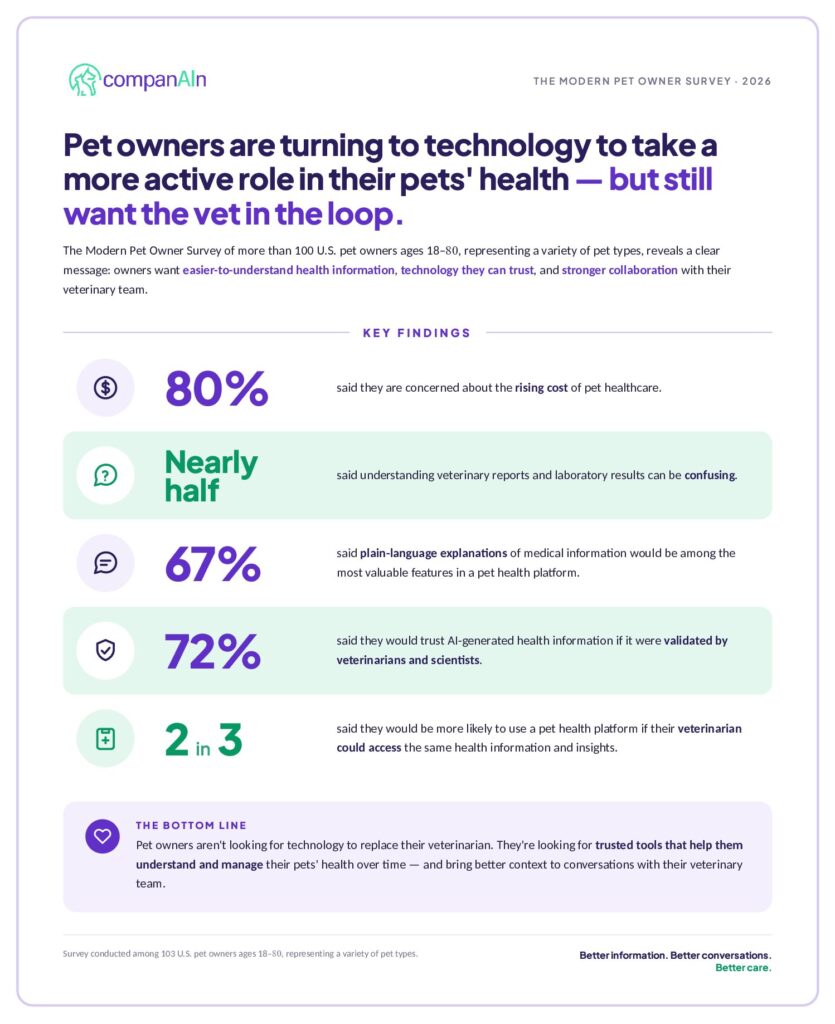
Key findings:
- 80% said they are concerned about the rising cost of pet healthcare.
- Nearly half said understanding veterinary reports and laboratory results can be confusing.
- 67% said plain-language explanations of medical information would be among the most valuable features in a pet health platform.
- 72% said they would trust AI-generated health information if it were validated by veterinarians and scientists.
- 2 in 3 said they would be more likely to use a pet health platform if their veterinarian could access the same health information and insights.
“Today’s pet owners aren’t looking for technology to replace their veterinarian, they’re looking for technology that helps them become better partners in their pet’s care,” said Michelle Wiltse, founder and CEO of CompanAIn. “Our research suggests owners want trusted tools that help organize information, explain what they’re seeing and create more productive conversations with their veterinary team.”
The findings reflect a broader shift in consumer behavior as pet owners increasingly manage health information from multiple sources, including veterinary clinics, specialists, diagnostic laboratories, pharmacies, Google and emerging AI tools. This creates new opportunities, and responsibilities, for technology companies developing solutions for animal health.
Why Owners Are Turning to Technology
For many pet owners, technology use has become part of what happens between veterinary visits. A question that once might have waited for the next appointment can now be searched online in seconds, while digital tools make it easier to track changes, organize records and seek explanations.
But access to more information doesn’t necessarily make it easier to understand an individual pet’s health. Nearly half of survey respondents said understanding veterinary reports and laboratory results can be confusing, while 67% identified plain-language explanations as one of the most valuable features a pet health tool could provide.
The findings suggest that owners aren’t simply looking for more information. They’re looking for help understanding and organizing their specific pets’ health information over time and bringing that information back to their veterinary team.
Owners Are Open to AI—with Conditions
The survey also offers a more nuanced picture of how pet owners view AI in pet healthcare.
Seventy-two percent said they would trust AI-generated health information if it were validated by veterinarians and scientists. Nearly two-thirds said they would be more likely to use a pet health platform if their veterinarian could access the same health information and insights.
Together, the findings suggest that pet owners are open to technology as a partner in managing their pets’ health but they want trust, context and a connection to their veterinary team.
“Pet owners are clearly looking for better information and more ways to participate in their pets’ care, but they don’t want technology to replace their veterinarian,” Wiltse said. “What they want is a better way to understand what is happening and to bridge the gap between veterinary visits so they can bring that information back to the people they trust with their pets’ care.”
The findings also point to a broader shift in the relationship between pet owners, technology and veterinary medicine. As owners increasingly turn to online search and emerging AI tools for answers about symptoms, medications and health information, the challenge is not simply providing more information. It is providing information with context, continuity and appropriate clinical oversight.
“The conversation isn’t whether AI belongs in pet healthcare,” Wiltse said. “It’s whether pet owners can trust the information they’re receiving. The future belongs to technology that preserves context, supports clinical decision-making and strengthens the relationship between pet owners and veterinarians.”
The survey suggests that as technology becomes a more common part of how pet owners manage their animals’ health, the opportunity is not simply to make more information available. It is to help owners make better sense of that information while strengthening the connection between what happens at home and the care provided by veterinary teams.
About CompanAIn:
CompanAIn is an AI-powered pet health platform that helps pet owners better understand, manage and support their pets’ wellbeing through personalized, contextual insights. It is building the agentic operating layer for pet health – a connected system that unifies fragmented information across the home, veterinary clinic and broader care ecosystem. Designed with responsible AI, CompanAIn enhances, not replaces, veterinary medicine. For more information, visit: https://companain.ai