
Dog Liver Enzymes Over 1000: When Lab Results Hit Four Digits
Dog liver enzymes over 1000 aren’t numbers you forget. When your veterinarian delivers that news, the conversation can feel disorienting—blood panels, ultrasounds, potential biopsies, medication trials.
Those elevated readings point to significant hepatocellular injury. But enzyme levels above 1000 don’t automatically predict outcomes. Dogs with ALT exceeding 5,000 have recovered completely after acute injuries. Meanwhile, moderate elevations sometimes signal chronic conditions requiring long-term management. The pattern matters more than the peak.
CompanAIn’s multi-agent AI system organizes your dog’s medical records into a living timeline that tracks enzyme trends over weeks and months. When ALT jumps from 300 to 1,200, or AST climbs steadily across three blood panels, those patterns tell stories that single snapshots can’t. The platform flags concerning trends and builds comprehensive health reports that help both owners and veterinarians spot what’s happening beneath the surface.
What ALT and AST Actually Measure
Alanine aminotransferase lives primarily inside liver cells. When hepatocytes suffer damage or die, ALT spills into the bloodstream. Normal canine ALT ranges from 12 to 118 U/L, though some laboratories use slightly different reference intervals. Readings above 1000 represent roughly 10-fold elevations—a sign that liver cells are leaking enzymes at alarming rates.
AST operates differently. Found in both the cytosol and mitochondria of hepatocytes, aspartate aminotransferase also exists in muscle tissue, red blood cells, and cardiac cells. Normal canine AST ranges from 15 to 66 U/L. When both ALT and AST climb together past 1000, veterinarians read these high liver enzymes as evidence of significant hepatocellular injury affecting the dog’s liver, then compare liver enzymes in dogs with other liver enzymes to judge whether the pattern points away from muscle injury. The pattern reveals where the problem originates.
The body clears ALT from circulation within 60 hours in dogs. AST disappears even faster, with a half-life of about 22 hours. These short clearance times explain why enzyme levels plummet rapidly once liver injury stops. Numbers that stay elevated despite treatment suggest ongoing damage. Levels that drop week over week signal healing.
Primary Causes Behind Critical Elevations
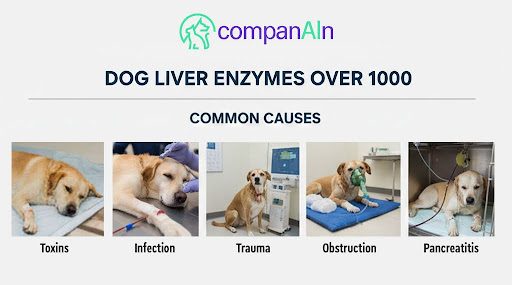
Toxin Ingestion
Dogs encounter hepatotoxins more often than owners realize. Elevated liver enzymes and increased liver values can reflect hepatic disease or extra-hepatic disease. The degree and pattern of liver enzyme elevations and increased liver enzymes help prioritize the most likely cause categories discussed below. Common culprits include:
- Xylitol poisoning from sugar-free products
- Mushroom ingestion
- Blue-green algae exposure
- Certain medications (phenobarbital causes slower elevations, while others produce acute spikes exceeding 1000 within hours)
Acute toxic injury often sends enzymes skyrocketing rapidly, then declining quickly once the substance clears. Persistently elevated enzymes suggest continued exposure or secondary complications. In severe cases, this can progress to liver failure with behavior changes, confusion, or seizures.
Infectious and Inflammatory Hepatitis
Bacterial infections, viral diseases, and immune-mediated conditions can inflame liver tissue severely. Major infectious causes producing significant ALT and AST elevations include:
- Leptospirosis
- Infectious canine hepatitis
- Chronic active hepatitis
These conditions differ from toxin exposure in their progression—enzymes may climb gradually over days or weeks, and worsening clinical signs can point to a more serious course.
Breed predispositions complicate diagnosis. Dogs at higher risk for chronic hepatitis include:
- Labrador Retrievers
- Bedlington Terriers
- West Highland White Terriers
- Doberman Pinschers
Some cases stem from copper accumulation in liver tissue, while others involve immune system dysfunction. Blood work alone can’t distinguish between causes. Persistently elevated enzymes suggest continued exposure or secondary complications. Severe toxic injury can progress to liver failure if treatment is delayed.
Acute Liver Injury from Trauma or Shock
Blunt force trauma to the abdomen, heatstroke, or severe systemic illness can damage liver tissue rapidly. Poor blood circulation from heart failure sometimes starves hepatocytes of oxygen, triggering cell death and enzyme release. Blood work alone can’t distinguish between causes. Clinical signs help determine how urgently inflammatory or infectious hepatitis needs to be investigated, especially in dogs with inflammatory bowel disease.
Pancreatitis frequently causes collateral liver damage. The inflammatory cascade from an inflamed pancreas affects nearby organs, including the liver. Dogs presenting with both elevated pancreatic lipase and liver enzymes over 1000 face dual challenges.
Bile Duct Obstruction and Cholestasis
While ALT and AST primarily indicate hepatocellular damage, severe blockage in the bile ducts can produce mixed enzyme patterns with both cholestasis and liver cell damage. Gallstones, tumors, or inflammation involving the gall bladder or obstructing bile flow create pressure that damages hepatocytes. Elevated enzymes are not always caused by primary liver injury, and conditions such as Cushing’s disease can complicate interpretation.
Complete bile duct obstruction requires surgical intervention. Medical management alone won’t resolve mechanical blockages, and delays worsen liver damage. Dogs with chronic inflammatory bowel disease may also need closer monitoring when liver abnormalities appear.
Why Severity Doesn't Equal Prognosis
The liver possesses remarkable regenerative capacity. Hepatocytes can regrow and restore function even after extensive damage, and obstruction within the bile ducts or near the gall bladder can create mixed enzyme patterns—assuming the underlying cause stops and supportive care continues. A dog with ALT at 5,000 from acute toxin exposure might recover completely within weeks, while pressure from obstruction can cause secondary liver cell damage and another with persistent ALT at 800 from chronic hepatitis could reflect significant liver disease with progressive fibrosis.
Veterinary research from Texas A&M University emphasizes this disconnect between peak enzyme levels and outcomes. Dogs with sky-high ALT from acute injury often make full recoveries when supported through the initial crisis.
Trend analysis matters infinitely more than single measurements. CompanAIn’s Living Memory technology tracks enzyme patterns across multiple blood panels, revealing whether levels are climbing, plateauing, or declining. That longitudinal view helps distinguish reversible acute injuries from progressive chronic disease.
The Diagnostic Journey After Critical Results
Immediate Follow-Up Testing
When ALT or AST exceeds 1000, veterinarians typically order additional blood work. Enzyme spikes this high usually warrant further investigation, especially when a dog’s symptoms suggest more than a transient lab abnormality. The goal is to use blood tests and liver function tests to assess liver function and determine whether the numbers reflect a primary liver problem or another disorder affecting the liver secondarily.
- Complete blood counts check for infection or anemia
- Coagulation panels evaluate blood clotting and whether the liver is making enough clotting factors; some advanced coagulation testing may only be available through larger veterinary hospitals
- Bile acid testing evaluates actual liver function rather than just damage markers
Abdominal ultrasound comes next in most protocols. Imaging reveals:
- Liver size and architecture
- Masses or nodules
- Bile duct dilation
- Fluid accumulation
- Suspicious lesions (can be sampled via ultrasound-guided fine needle aspiration)
Pattern Recognition Through AI Analysis
CompanAIn’s multi-agent system excels at identifying patterns in serial lab work. The platform compares current liver enzyme levels against historical trends, flags unusual spikes or gradual increases, and correlates bloodwork changes with medication adjustments or dietary modifications documented in veterinary notes.

When ALT or AST exceeds 1000 on blood tests and liver function tests, context matters. When ALT climbs from 250 to 450 to 875 across three months, that progression suggests different causes than a sudden jump from 85 to 1,200 overnight. The Health Analyzer agent spots these distinctions automatically, generating alerts that prompt timely veterinary consultations and helping owners track changing liver values over time.
- Coagulation testing assesses blood clotting and whether the liver is producing adequate clotting factors.
- Bile acid testing helps veterinarians assess liver function.
- Some advanced coagulation or related testing may be processed through larger veterinary hospitals.
Breed-Specific Considerations
Certain breeds require adjusted interpretation:
- Scottish Terriers, Siberian Huskies, and Miniature Schnauzers often show benign ALP elevations
- Bedlington Terriers and Labrador Retrievers face higher risks for copper-associated hepatitis
- Puppies normally carry elevated ALP from bone growth, though ALT and AST should remain within standard ranges
- Senior dogs sometimes develop benign nodular hyperplasia—aging changes that mildly increase enzymes without affecting function
Treatment Approaches for Critical Elevations
Addressing Underlying Causes
Treatment effectiveness depends entirely on identifying and targeting the root problem, because veterinarians treat the diagnosis causing the elevation rather than the enzyme value alone:
- Bacterial infections respond to appropriate antibiotics
- Immune-mediated hepatitis often requires immunosuppressive medications
- Copper-storage disease needs chelation therapy combined with low-copper diets
- Some cases involving liver tumors may require surgical treatment or specialist referral
- A diagnosis such as liver cancer usually carries a more guarded prognosis and needs urgent veterinary management
Toxin ingestion demands immediate intervention:
- Induced vomiting if recent
- Activated charcoal to bind remaining toxins
- IV fluid therapy to support kidney function and blood pressure
- Specific antidotes depending on the substance involved
Supportive Care and Monitoring
Dogs with enzymes exceeding 1000 typically need hospitalization for stabilization:
- IV fluid therapy maintains hydration and supports kidney function while the liver recovers
- Anti-nausea medications keep dogs comfortable and encourage eating
- Serial blood chemistry panels track enzyme trends during treatment
If imaging suggests liver tumors or liver cancer, treatment may shift toward surgery, oncology referral, or biopsy-guided planning. Recheck testing is often needed within a few weeks to confirm the trend is moving in the right direction.
Declining numbers confirm that interventions are working. Plateauing or rising enzymes despite treatment suggest the underlying cause hasn’t been fully addressed.
Medications That Support Liver Recovery
Common hepatic support medications include:
- SAMe (S-adenosylmethionine) supplements like Denamarin provide antioxidant support during liver recovery, and some vets also use milk thistle alongside a prescription diet to support liver health.
- Ursodiol increases bile flow and reduces inflammation in cholestatic conditions to help support liver function.
- Vitamin E offers additional antioxidant protection
Some cases require more aggressive intervention:
- Chronic hepatitis might need corticosteroids or other immunosuppressive drugs
- Copper-storage disease requires penicillamine for copper chelation
CompanAIn’s platform tracks medication changes alongside lab results, helping identify which treatments correlate with improving enzyme levels, with meaningful trend changes often becoming clearer over the next few weeks of monitoring.
Tracking Recovery Through Organized Health Records
The challenge with liver disease management isn’t just getting initial treatment right—it’s maintaining consistent monitoring over months of recovery. The requirements pile up quickly:
- Blood panels repeated every two weeks initially, then monthly, then quarterly
- Medication doses adjusted based on response
- Dietary modifications refined as tolerance changes
This extended management generates mountains of records: lab reports, ultrasound images, medication lists, veterinary visit summaries, owner observations. Keeping everything organized manually becomes overwhelming. Details slip through cracks.
consolidates all this scattered information into a single, chronological health timeline. Upload bloodwork PDFs, and the AI extracts enzyme values automatically. Add vet visit notes, and the system identifies medication changes or new symptoms. The platform remembers that ALT was 1,250 four months ago, then 890, then 645, then 420—showing clear downward trajectory.
This organized historical view proves invaluable during follow-up appointments. Veterinarians can quickly see:
- How enzymes have trended across the entire treatment period
- Whether improvement plateaued recently
- If any interventions correlated with setbacks
- How current readings compare to initial crisis levels
When Enzyme Levels Stay Elevated Despite Treatment
Not every dog responds to initial treatment attempts. Persistently elevated levels signal several possibilities: the underlying diagnosis was incomplete, complications developed during treatment, the condition has progressed to irreversible fibrosis, or the chosen intervention isn’t effective.
Persistent elevations typically prompt escalation to liver biopsy if not already performed. Microscopic examination reveals inflammation patterns, copper accumulation, architectural changes, fibrosis staging, and potential neoplasia that other diagnostics miss.
Referral to veterinary internal medicine specialists becomes appropriate when general practitioners exhaust standard options. Board-certified internists bring specialized expertise in hepatobiliary disease and experience managing complex cases.
The Role of AI in Long-Term Liver Health Management
Chronic liver conditions require years of monitoring because the liver supports detoxification and other essential functions throughout a dog’s body. Dogs with copper-storage disease need lifelong dietary restrictions and periodic chelation. Chronic hepatitis cases may require ongoing immunosuppression. Advanced imaging or specialty referral may also be needed to rule out a liver shunt when routine testing does not explain persistent abnormalities.
This extended surveillance generates exactly the kind of longitudinal data that AI analysis handles exceptionally well. CompanAIn’s Recommendation Engine suggests when follow-up bloodwork is due based on previous test intervals. The system flags any enzyme creep upward that might signal relapse.
The Living Memory feature maintains complete context from initial diagnosis through every treatment adjustment and outcome. New veterinarians inheriting the case can review the entire journey, understanding what’s been tried, what worked, and what didn’t.
FAQ
How quickly do liver enzymes drop after treatment starts?
ALT and AST decline rapidly once liver damage stops—sometimes dropping 50% within the first week of effective treatment. However, initial increases can occur during the first few days as damaged cells continue releasing enzymes. Expect levels to peak within 2-3 days, then begin declining if treatment addresses the underlying cause.
Can dogs with enzymes over 1000 fully recover?
Absolutely. Recovery depends on the cause, not the peak enzyme level. Dogs with acute toxin exposure often make complete recoveries even from readings exceeding 5,000. The liver’s regenerative capacity is remarkable when given proper support and the injurious process stops, while prognosis is more guarded with chronic liver disease. Alkaline phosphatase may decline more slowly than ALT and AST, so improvement can lag on some panels.
Should I change my dog's diet immediately?
Discuss dietary changes with your veterinarian before making modifications. Highly digestible proteins support liver recovery, while excessive copper or salt can worsen certain conditions because the liver is a vital organ. Full recovery is less likely when enzymes this high reflect chronic liver disease rather than a reversible acute event. Commercial hepatic support diets exist, but appropriateness depends on the specific diagnosis.
How often will my dog need blood work rechecked?
Initial monitoring typically involves blood panels every 1-2 weeks until enzymes show clear declining trends. Once stable improvement is documented, testing intervals extend to monthly, then every 3-6 months. Dogs with chronic conditions may need lifelong quarterly or biannual bloodwork.
What symptoms should prompt emergency vet visits during treatment?
Yellowing of eyes or gums (jaundice), sudden appetite loss, repeated vomiting, disorientation or behavior changes, abdominal distension, and collapse all warrant immediate veterinary attention. These signs suggest worsening liver function or complications requiring urgent intervention.
How does CompanAIn help with liver disease management?
organizes all medical records, lab results, and veterinary notes into a chronological health timeline. The AI tracks enzyme trends across multiple blood panels, flags concerning patterns, and generates comprehensive reports perfect for sharing with your veterinary team.