
If your dog panics every time you pick up your keys, destroys the door frame while you’re at work, or howls non-stop until you return, you’re not alone. Separation anxiety in dogs is one of the most common behavioral challenges pet owners face, and it can feel overwhelming when you don’t know where to start. This guide walks you through everything from recognizing the first warning signs to building a long-term treatment plan that actually works.
Answering Your Biggest Questions About Separation Anxiety ASAP
If you’re reading this in a moment of frustration or worry, this section is for you. Here are the quick answers to “Does my dog have separation anxiety, and what do I do right now?” before we go deeper.
What separation anxiety is:
- A panic-type anxiety disorder in dogs that occurs when they are separated from their primary caregiver or left alone
- Not spite, stubbornness, or attention seeking behavior-it is genuine emotional distress
- Completely treatable with the right combination of support
Most common signs:
- Excessive barking, howling, or whining shortly after you leave
- Destructive behavior at exit points (doors, windows)
- House soiling despite being completely house trained
- Pacing, drooling, panting, or refusal to eat
First steps checklist:
- Record video or audio of your dog during the first 30–60 minutes after you leave.
- Visit your veterinarian to rule out medical problems (urinary infections, pain, endocrine issues).
- Do not punish your dog for any damage or accidents-punishment makes anxiety worse.
- Arrange a temporary dog sitter, neighbor, or doggy daycare to reduce your dog’s alone time while you plan next steps.
- Start simple independence exercises at home (being nearby but not interacting, short out-of-sight moments).
CompanAIn’s health and behavior timeline can help you track symptom onset, log departure events and durations, store video clips, and share trend summaries with your vet so appointments are more productive from the start.
What Is Separation Anxiety in Dogs?
Separation anxiety-sometimes called canine separation anxiety or separation related behavior (SRB)-is a behavioral disorder in which a dog experiences intense panic and distress when separated from an attachment figure or left alone. Separation anxiety in dogs occurs when they are left alone or separated from their primary caregiver. It is not a training failure or a personality flaw. Think of it as the canine equivalent of a panic attack: the dog’s anxiety is real, involuntary, and overwhelming.
The difference between normal and problematic is important. Most dogs protest a departure briefly-a whine at the door, a bark or two-then settle down within minutes. True separation anxiety looks nothing like that. The distress persists. The dog cannot self-soothe, cannot relax, and may spend the entire absence in a state of escalating panic. A dog’s behavior during these episodes is driven by fear, not choice.
Any breed, any age, any background can be affected. Even dogs raised in stable, loving homes can develop separation anxiety when life circumstances shift. It tends to persist across different living situations, confirming that it is about the dog’s emotional state rather than a specific environment.
A few key terms worth knowing:
- Separation distress – the internal emotional state (panic, fear) the dog experiences during absence
- Separation related behavior (SRB) – the external signs: barking, destruction, soiling, pacing
- Hyper-attachment – excessive dependency where the dog becomes distressed even when the owner simply moves to another room
How Common Is Separation Anxiety and Why It Matters
Separation anxiety is far more prevalent than many owners realize. A large US survey using the mini C-BARQ instrument across approximately 43,500 pet dogs found that roughly 9.3% showed moderate to severe separation related behavior. Among domestic dogs referred to behavior clinics in North America, the figure is even higher-20–40% of cases involve separation anxiety. Many dogs suffering from milder forms are never identified because the signs happen only in the owner’s absence.
Impacts on the dog:
- Chronic stress with elevated cortisol levels
- Risk of self-injury: broken teeth from gnawing at crates, torn nails from scratching doors, lacerations from crashing through barriers
- Escalation over time if left untreated-canine anxiety rarely resolves on its own
Impacts on people:
- Property damage (chewed door frames, scratched flooring, soiled carpets)
- Noise complaints from neighbors due to hours of barking
- Emotional distress, guilt, sleep disruption, and strained relationships
- In severe cases, owners feel forced to consider rehoming-one of the leading reasons dogs end up in shelters
Dogs suffer silently in many households. Owners assume their dog “just sleeps all day,” but without a camera running, they never see the pacing, whining, or frantic escape attempts. A health timeline-like the one available in CompanAIn’s AI-powered pet health platform-lets owners correlate spikes in separation anxiety with specific events such as moves, schedule changes, or illnesses, revealing patterns that are invisible otherwise.
Typical Signs and Symptoms of Separation Anxiety
The hallmark of separation anxiety is context-dependent: unwanted behavior appears shortly after departure and is absent when the dog is relaxed with the owner present. Common signs of separation anxiety include excessive vocalization and destructive behavior that occur specifically during the owner’s absence.
Hallmark symptoms:
- Excessive barking or howling that begins within minutes of being left alone
- Continuous whining or crying
- Pacing in a fixed pattern (back and forth along a wall, circling)
- Destructive chewing and digging at exit points-doors, windows, walls, crate bars
- House soiling: dogs urinate or defecate indoors despite being reliably house trained
- Attempts to escape confinement, sometimes resulting in injury
- Drooling, panting, excessive salivation
- Refusal to eat or engage with any dog toy, even high-value treats
- Frantic, over-the-top greeting behavior when the owner returns
- Self-injury: chewing paws, licking until sores develop
Mild, moderate, and severe patterns:
Severity | What it looks like |
|---|---|
Mild | Whines for 5–10 minutes, then settles; occasional pacing; may take a food toy |
Moderate | Vocalization persists 30–60 minutes; some destructive behavior; drooling and panting; reluctant to eat |
Severe | Immediate panic upon departure; nonstop distress for hours; severe destruction; self-harm; refuses all food; may injure self attempting escape |
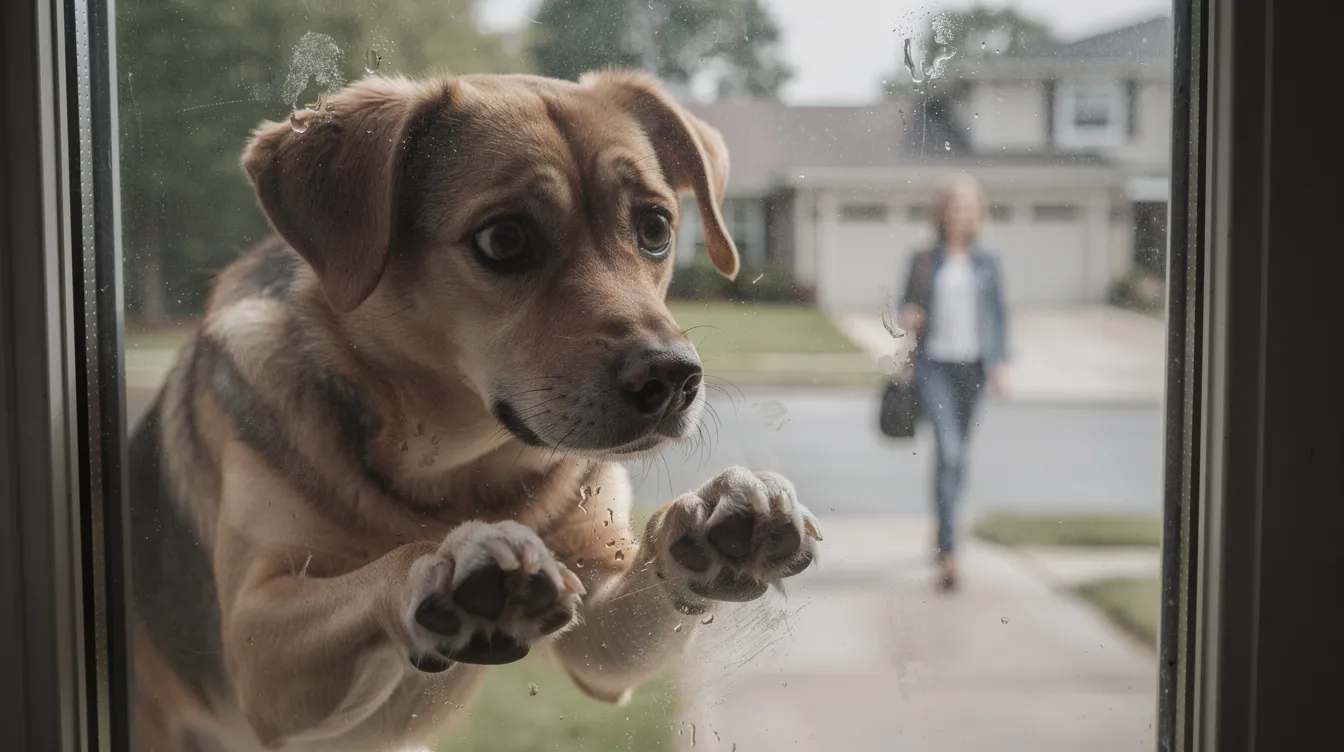
Watch for “Velcro dog” tendencies: a dog that follows you to every room, becomes anxious the moment you reach for your keys, and cannot tolerate being out of your dog’s sight even within the home. These patterns of hyper-attachment often accompany or precede separation anxiety.
To document what’s actually happening, set up a camera to record the first 30–60 minutes after departure. You can log and review these observations in an app like CompanAIn’s symptom checker to build a clear picture over time.
Medical Problems and Other Conditions That Can Look Like Separation Anxiety
Before concluding your dog has separation anxiety, a veterinarian must rule out physical and other behavioral causes. Several medical problems can produce symptoms that overlap with or worsen a dog’s anxiety.
Medical conditions to rule out:
- Urinary tract infections causing urgency or urinary incontinence
- Age-related bladder weakness (especially in older female dogs)
- Endocrine disorders such as Cushing’s disease or diabetes that increase thirst and urination
- Orthopedic or dental pain making the dog restless
- Neurological conditions
- Medication side effects (e.g., steroids increasing thirst and causing accidents)
Non-anxiety behavioral issues often confused with separation anxiety:
- Incomplete house training, particularly in puppies or newly adopted dogs
- Normal juvenile destructive chewing (teething)
- Boredom or insufficient mental stimulation in under-exercised dogs
- Barrier frustration (damage to windows when animals pass outside)
- Noise phobia (fear of thunder, fireworks) unrelated to the owner’s departure
- Cognitive dysfunction in senior dogs causing disorientation and house soiling
In true separation anxiety, problematic behaviors occur primarily or only when the dog is alone or separated from a specific person. If destruction also happens when the owner is home, the cause is likely something else entirely.
A vet visit typically includes a thorough history review, physical exam, urinalysis, and possibly bloodwork to rule out underlying disease. Only once medical causes are excluded does a behavioral diagnosis of canine separation anxiety solidify. The field of veterinary medicine continues to refine diagnostic protocols to ensure accurate identification.
Risk Factors and Why Some Dogs Develop Separation Anxiety
There is no single cause. Dogs develop separation anxiety through a combination of genetics, early life experiences, environment, and life events.
Known risk factors:
- Dogs separated from their litter before 60 days are at higher risk for anxiety-related behavior later in life
- Limited socialization during the critical 5–10 month developmental window
- Dogs adopted from shelters are more prone to separation anxiety, likely due to the disruption and unknown early history that many shelter dogs carry
- Changes in household membership can trigger separation anxiety-a family member moving out, a divorce, or the loss of another pet
- Abrupt changes in a dog’s schedule can lead to anxiety, such as an owner who worked from home suddenly returning to the office
- Dogs living in apartments show higher rates of separation anxiety, possibly due to limited space and stimulation
Demographic patterns from research:
- Studies suggest slightly higher prevalence in some male dogs, though findings vary; female dogs are not immune
- Dogs exposed to frequent rehoming or boarding are overrepresented
- A Finnish study of approximately 13,700 dogs found comorbidity between separation anxiety, noise sensitivity, and fearfulness, suggesting shared genetic risk
Inconsistent routines-owners who are constantly present and then suddenly away for long stretches-create the conditions where dogs develop separation anxiety most readily. Chronic over-attachment without any alone-time training amplifies the risk.
Recording major life events in a health timeline helps you see exactly when separation related behaviors began or escalated. A move in March, a new baby in July, a schedule change in September-these data points give your vet actionable context.
How Separation Anxiety Is Diagnosed
Diagnosing a dog’s separation anxiety follows a structured process combining observation, history, and professional evaluation.
Key diagnostic criteria:
- Distress behaviors (vocalizing, destruction, house soiling, pacing) occur only or mainly when the dog is alone or away from an attachment figure
- Symptoms typically begin within minutes of the owner’s departure-often within the first 10–30 minutes
- The dog is calm and behaves normally when the owner is present
The role of video and audio recording:
A camera pointed at the main living space, door, or crate during a typical workday departure is one of the most valuable diagnostic tools. It confirms timing, severity, and type of anxious behaviors with objectivity that verbal descriptions cannot match.
Behavioral history matters:
Your vet or behaviorist will ask about puppyhood experiences, adoption source, prior training sessions, schedule changes, and any known fears. A dog with noise phobia and a history of frequent rehoming, for example, carries a different risk profile than a puppy raised in one home.
CompanAIn can help owners compile a structured pre-visit summary-a timeline of life events, observed symptoms with timestamps, and notes about triggers-that can be shared securely with the vet for a more productive appointment.
Differential Diagnosis: Conditions Commonly Confused With Separation Anxiety
Before confirming separation anxiety, a vet will consider several alternative explanations. Separation related disorders share surface-level symptoms with other conditions, and getting this right determines whether the treatment process will actually work.
Conditions to differentiate:
- Confinement distress – panic only when crated or behind gates; removing confinement often resolves most signs, whereas true separation anxiety persists in open settings
- Barrier frustration – destructive behavior at windows or doors triggered by visible people or animals outside, not by the owner’s absence
- Generalized anxiety – an anxious dog in multiple contexts (strangers, new places, handling), not exclusively when alone
- Noise phobia – vocalization and pacing triggered by storms or fireworks, unrelated to separation
- Obsessive compulsive disorder – repetitive compulsive behaviors (tail chasing, shadow chasing, flank sucking) that occur regardless of whether the owner is present
- Cognitive dysfunction – senior dogs showing disorientation, altered sleep cycles, and house soiling that is not linked to alone-time
- Boredom – destruction from a dog that simply needs more exercise and mental stimulation
Careful pattern tracking-when, where, and how often behaviors occur-helps distinguish these conditions. Does the dog panic only when crated, or also when free in the house? Does destruction happen only during the owner’s absence, or also at night while the owner sleeps in the next room? Diaries or apps that capture this level of detail make differential diagnosis faster and more accurate.
Immediate Management: What to Do If Your Dog Has Separation Anxiety Right Now
While you build a long-term plan, your dog needs relief today. These short-term strategies for behavior management reduce distress during the transition.
Reduce alone time immediately:
- Use a dog sitter, trusted neighbor, or doggy daycare to limit how long the dog spends completely alone
- If your workplace allows it, bring your dog home with you or arrange a dog walker for midday visits
- Even a few hours of company can dramatically lower daily distress
Environmental tweaks:
- Use a safe room instead of a crate for dogs that panic when confined
- Block outside views if barking at passers-by worsens the dog’s anxiety
- Play white noise or calming music to mask triggering sounds
- Leave a worn T-shirt with your scent near the dog’s resting area
What not to do:
- Never punish your dog on return for damage, noise, or accidents-dogs cannot connect delayed punishment to earlier behavior, and it increases anxiety in dogs
- Remove shock collars, spray collars, or any aversive device-these worsen fear
- Low-key departures and arrivals help prevent anxiety in dogs with separation issues; avoid dramatic goodbyes and frantic hellos
Start a simple log-whether in CompanAIn or a notebook-tracking each day’s absences, duration, signs of anxiety, and what management worked. This gives both you and your vet clearer insight from the very first appointment.
Behavior Modification: Core Principles for Treating Separation Anxiety
Behavior modification is the cornerstone of any separation anxiety treatment plan. Anti anxiety medication, pheromones, and environmental changes support the treatment process, but they do not replace the work of changing how your dog feels about being alone.
The two core techniques:
- Systematic desensitization – very gradually increasing alone-time duration, always staying below the threshold where the dog’s anxiety kicks in. Desensitization involves exposing dogs to departure cues at low intensity to reduce anxiety responses over time.
- Counterconditioning – pairing the experience of being alone with something genuinely positive (a high-value food stuffed toy, a special chew) so the dog begins to associate alone-time with good things rather than panic. Counterconditioning associates being alone with positive experiences.
Progress must move at the dog’s pace. If you push too fast, you sensitize rather than desensitize-creating setbacks instead of gains. Consistency and patience matter more than speed. Aim for five or fewer core action steps at a time to avoid overwhelm.
Schedule regular check-ins (monthly is a good rhythm) with your vet or behavior professional. Keep records of progress in a timeline to track what’s working, stay motivated, and adjust when needed. Medication is often combined with behavior modification for effectiveness, especially in moderate to severe cases.
Step-by-Step Desensitization to Owner Absences
Systematic desensitization and counterconditioning are effective treatment methods for dogs with separation anxiety. Here is a high-level protocol for graded departures.
Step-by-step sequence:
- Mat relaxation with owner present – teach your dog to settle on a mat or bed while you move around the room, doing non-dog-focused tasks. Reward calm behavior.
- Brief out-of-sight moments – step out of the dog’s sight for 2–5 seconds, then return calmly. No fanfare. Repeat until the dog shows zero concern.
- Extend duration gradually – increase to 10 seconds, 30 seconds, 1 minute, 2 minutes. Only move forward when the dog remains relaxed at the current level for multiple repetitions.
- Close a door – practice closing an interior door between you and the dog for brief periods, then opening it and returning. Reward calm.
- Step outside – move to the exterior door: open, step out, step back in. Gradually increase time outside.
- Simulate real departures – pick up keys, put on shoes, walk out, sit in the car for 30 seconds, come back. Desensitize each departure cue by performing these actions randomly without actually leaving.
- Build to realistic durations – as tolerance grows, extend to 5, 10, 15, 30 minutes and beyond. Desensitization gradually increases the duration of separations at a pace the dog can handle.
Short absences help dogs learn to cope with being alone. Early sessions may be as brief as a few seconds. Gradually increasing alone time builds the dog’s tolerance to separation in a way that feels safe rather than threatening.
Jumping too quickly-say, from 5 calm minutes to a 60-minute departure-can undo weeks of progress. If the dog shows distress at a new duration, step back to the last successful level and hold there longer before trying again.
Mark each successful duration and any signs of distress in a tracking tool. This data helps you fine-tune progression and gives your behaviorist concrete evidence to guide adjustments.
Using Food Toys and Enrichment to Change How Your Dog Feels About Being Alone
A food toy-puzzle feeder, stuffed Kong, or snuffle mat-can transform alone-time from something terrifying into something the dog actually looks forward to. Providing food-stuffed toys can distract dogs during separations and serve as a powerful counterconditioning tool.
Concrete options:
- Frozen Kong stuffed with canned dog food, peanut butter (xylitol-free), or mashed banana
- Treat-dispensing balls filled with kibble mixed with a few high-value treats
- Slow feeders or snuffle mats that encourage natural foraging behavior
- Long-lasting chews appropriate for your dog’s size and dental health
For many dogs with severe anxiety, they will initially ignore food entirely-even their favorite treats. This is a clear signal that the dog’s anxiety is too high and the absence duration needs to be scaled back before enrichment can work.
Teach your dog to enjoy these toys while you’re still home and relaxed. If the food toy only appears right before you walk out the door, the dog takes it as a cue for stress rather than a reward. Use it during calm evenings, during independence training, any time you want to keep your dog busy in a positive way.
Adjust daily calorie intake to account for food toy calories-overfeeding is a common mistake. Log which toys hold your dog’s attention longest and which get ignored; this builds a personalized enrichment plan that evolves with the dog’s progress.
Creating a Safe, Relaxing Environment for Alone-Time
Where the dog spends time alone matters. A thoughtfully set up “safe haven” can meaningfully reduce the intensity of separation distress.
Choosing and setting up the space:
- Pick a quiet room away from street-facing windows and the front door
- Provide a comfortable bed, a water bowl, and an item carrying the owner’s scent (worn clothing)
- Remove anything the dog could damage or that could injure the dog (electrical cords, fragile items)
Pre-associate the space with relaxation:
Before ever using it for departures, have your dog spend short, calm periods there while you’re present. Offer a chew, calmly pet them, let them nap. The room itself should signal “rest” long before it signals “alone.”
Crate training considerations:
Crate training can be helpful for dogs that were raised with positive crate associations and find the crate comforting. However, for a dog that already panics in confinement, a crate will worsen distress and risk injury. Match the approach to the individual dog.
Soothing aids to experiment with:
- Soft lighting and white noise or classical music
- Dog appeasing pheromone (DAP) diffusers placed in the safe room
- Anxiety wraps or pressure vests for some dogs
Test different combinations and log which ones reduce signs most effectively. What works for one dog home may not work for another.
Independence Training and Reducing Hyper-Attachment
Dogs overly dependent on constant owner presence struggle more when separations happen. Independence needs to be trained gently-not by withdrawing affection, but by teaching the dog that being apart is safe.
Daily exercises:
- Reward your dog for choosing to rest away from you (on a bed across the room, in another area of the house)
- Use “settle” or mat training: send the dog to a designated spot, reward calm duration, gradually increase time and distance
- Practice short, planned periods of non-interaction-sit and read a book or work while the dog rests nearby without engaging
Ignoring clingy behavior reduces dependency on the owner over time. If your dog follows you to every room, avoid constantly reinforcing this by petting or talking to them each time. Instead, redirect them to their mat or an independent activity. This doesn’t mean being cold-it means balancing affection with autonomy so the dog learns that owner presence does not always equal direct attention.
You can still calmly pet your dog during quiet moments-the goal is shifting the pattern, not eliminating warmth. Track baseline attachment behaviors (e.g., follows to every room, whines when you close the bathroom door) and chart improvements as independence training progresses.
Drug Therapy, Pheromones, and Other Medical Supports
For many dogs with moderate to severe separation anxiety, drug therapy combined with behavior modification produces better outcomes than behavioral therapy alone. Veterinarians may prescribe medications to help manage severe separation anxiety when distress behaviors are too intense for training alone to address.
Primary medications (veterinary prescription required):
Medication | Class | Typical Dose | Notes |
|---|---|---|---|
Clomipramine (Clomicalm®) | Tricyclic antidepressant | Clomipramine is effective at a dose of 1 mg/kg every 12 hours | FDA-approved for canine separation anxiety |
Fluoxetine (Reconcile®) | SSRI | Per vet guidance | Fluoxetine improved separation anxiety symptoms in 72% of treated dogs in clinical trials |
Clomipramine and fluoxetine are approved medications for separation anxiety in dogs. Other SSRIs (sertraline, paroxetine) may be used off-label. For acute high-stress situations, short-acting anti anxiety drugs such as trazodone or clonidine can provide temporary relief. Benzodiazepines can reduce anxiety but may cause dependence with prolonged use, so they are typically reserved for specific situations rather than daily use.
Expected timelines and side effects:
Most anti anxiety medication requires 4–6 weeks to reach full effect. Common side effects include mild appetite changes, lethargy, and gastrointestinal upset. When a dog improves, dose reduction should happen gradually under veterinary supervision-never stop abruptly.
Pheromone therapy:
Synthetic dog appeasing pheromone (DAP) products-diffusers and collars-offer a low-risk complement. Research has shown that 83% of dogs showed reduced anxiety with dog-appeasing pheromones, though pheromones are rarely sufficient alone for moderate to severe cases. They work best layered with behavior modification and, when needed, medication.
Tools like CompanAIn’s lab interpretation and medication tracking help owners and vets monitor for side effects, schedule follow-up bloodwork, and correlate behavior changes with dose adjustments over time.
Working With Professionals: Vets, Trainers, and Behaviorists
Professional support is recommended for severe cases of separation anxiety, and even milder cases benefit from expert guidance to avoid common mistakes.
Who does what:
- Primary-care veterinarian – rules out medical problems, initiates treatment, prescribes medication
- Veterinary behaviorist or certified behavior consultant – creates detailed behavior modification plans for complex or severe cases
- Qualified positive-reinforcement trainer – helps implement day-to-day exercises, enrichment, and independence training sessions
What to bring to appointments:
- Video clips of your dog’s behavior during the owner’s absence
- A timeline of life events (moves, schedule changes, additions/losses of a family member)
- Notes on routines, prior training methods, and current medications or supplements
- Any structured data from a tracking app
Choose professionals who use humane, science-based, non-punitive methods. Trainers who recommend shock collars, choke chains, or flooding techniques for dogs with separation anxiety will almost certainly make the problem worse. Collaboration between your vet and behaviorist-ideally with a shared digital record-streamlines communication and ensures everyone is working from the same data.
Ask for clear, simple written plans with five or fewer core action steps at a time. Overwhelm is the enemy of consistency, and consistency is what drives successful treatment.
Preventing Separation Anxiety in Puppies and Newly Adopted Dogs
Preventing separation anxiety is far easier than treating it. Whether you’re bringing home a puppy or a newly adopted adult, the first weeks set the foundation for your dog’s life.
Early socialization guidelines:
- During the 5–12 week puppy window and up to 10 months, provide diverse, positive experiences: new people, new environments, and brief periods alone
- Dogs exposed to gradual, positive separations early are significantly less likely to develop anxiety later
- For adopted adults, introduce predictable schedules immediately and allow a decompression period
Teaching alone-time from day one:
- Start with minutes of separation inside the home-owner out of sight briefly, reward quiet behavior
- Use mat training or a designated rest area where the dog learns that independent play and relaxation are rewarding
- Keep arrivals and departures low-key; avoid dramatic goodbyes or excited returns
Routine stability:
Predictable feeding, potty breaks, exercise, and rest help puppies and new dogs feel secure. Consistency helps the dog predict what comes next, reducing anticipatory anxiety before it begins.
Monitor early signs of discomfort when the dog spends time alone. If whining escalates rather than diminishes over the first week, address it immediately with gentle training rather than waiting to see if the dog “grows out of it.” Using tools that track behavior trends catches issues before they become entrenched.
Lifestyle Adjustments, Dog Sitters, and Real-World Scheduling
For working owners, the reality of separation anxiety treatment means rethinking daily logistics. The goal is to avoid long, unbroken absences whenever possible-especially during the early weeks of treatment.
Practical options:
- Hire a dog sitter or dog walker for midday visits
- Use doggy daycare on days when long absences are unavoidable (ensure the facility is calm and staff can read stress signals in an anxious dog)
- Stagger schedules with a partner, roommate, or family member so the dog is rarely alone for a full workday
- Work from home certain days if your employer allows flexibility
For some dogs suffering from severe anxiety, avoiding true alone-time during the initial treatment phase is not a luxury-it’s a necessity. Every panic episode during unmanaged absence can reinforce the fear cycle and undermine your desensitization work.
Choosing a sitter or daycare for an anxious dog:
- Look for quiet environments with low dog-to-staff ratios
- Ask whether staff understand canine anxiety and will follow your behavior plan (medication schedule, enrichment routines)
- Visit before committing; observe noise levels, dog interactions, and staff responses to stressed dogs
- Some dogs find group daycare more stressful-an in-home sitter may be a better fit
Use a shared calendar or tracking app to coordinate care between household members and sitters so the dog’s alone-time and progress are consistently monitored. When everyone involved in the dog’s care is aligned, recovery accelerates.
Tracking Progress and Adjusting the Plan Over Time
Separation anxiety treatment can take weeks to months. Without systematic tracking, small improvements are easy to miss-and setbacks can go unnoticed until they escalate.
Key metrics to monitor:
- Time until first sign of distress after departure
- Total duration of vocalization or pacing
- Whether the dog will eat a food toy during absence
- Number of accidents or instances of destruction
- Recovery time and intensity of greeting when you return
How to make comparisons meaningful:
Keep your departure routine consistent-same cues, same order, same camera angle. If you change rooms, times, or routines, note it so you don’t confuse a variable change with a behavior change.
A digital health timeline like CompanAIn’s can compile absences, behavior notes, medications, and vet visits into one view, helping identify which interventions help most. Overlaying medication start dates, enrichment changes, and life events onto a behavior trend line reveals correlations that a simple diary can miss.
When to adjust:
If the dog’s attention to food toys improves, distress duration shortens, or the dog takes longer to show first signs of anxiety-these are wins. If there’s no improvement after 4–6 weeks of consistent effort (including medication if prescribed), consult your professional team for adjustments: a different medication, a modified desensitization protocol, or additional environmental changes.
Celebrate small milestones. Going from 30 seconds of calm to 5 minutes is meaningful progress. Dogs with separation anxiety can and do recover-patience and consistent effort are what get you there.
Key Takeaways and When to Seek Urgent Help
- Separation anxiety is common, affecting a significant percentage of pet dogs, and it is entirely treatable
- It reflects panic, not spite-your dog is not choosing these distress behaviors
- Accurate diagnosis matters: rule out medical problems and other conditions before committing to a treatment plan
- The strongest outcomes come from combining behavior modification, environmental changes, and, in many cases, drug therapy
- Successful treatment takes time, consistency, and data-track everything
Seek urgent veterinary help if:
- Your dog is self-injuring (broken teeth, bleeding paws, crashing through barriers)
- Dramatic weight loss from refusing food during absences
- Sudden onset of severe anxiety without an obvious trigger, which could signal a medical emergency
You are not failing your dog by facing this challenge. Many caring, dedicated owners deal with separation anxiety, and the fact that you’re educating yourself already puts you ahead. Use the resources available-your vet, a qualified behavior professional, and tracking platforms like CompanAIn-to build a clear, personalized plan.
With patience, the right support, and consistent effort, most dogs with separation anxiety go on to live calmer, happier lives. And so do their owners. Start with one small step today: record your dog’s behavior, talk to your vet, and know that the path forward is well-mapped. Your dog’s life-and your peace of mind-are worth the investment.