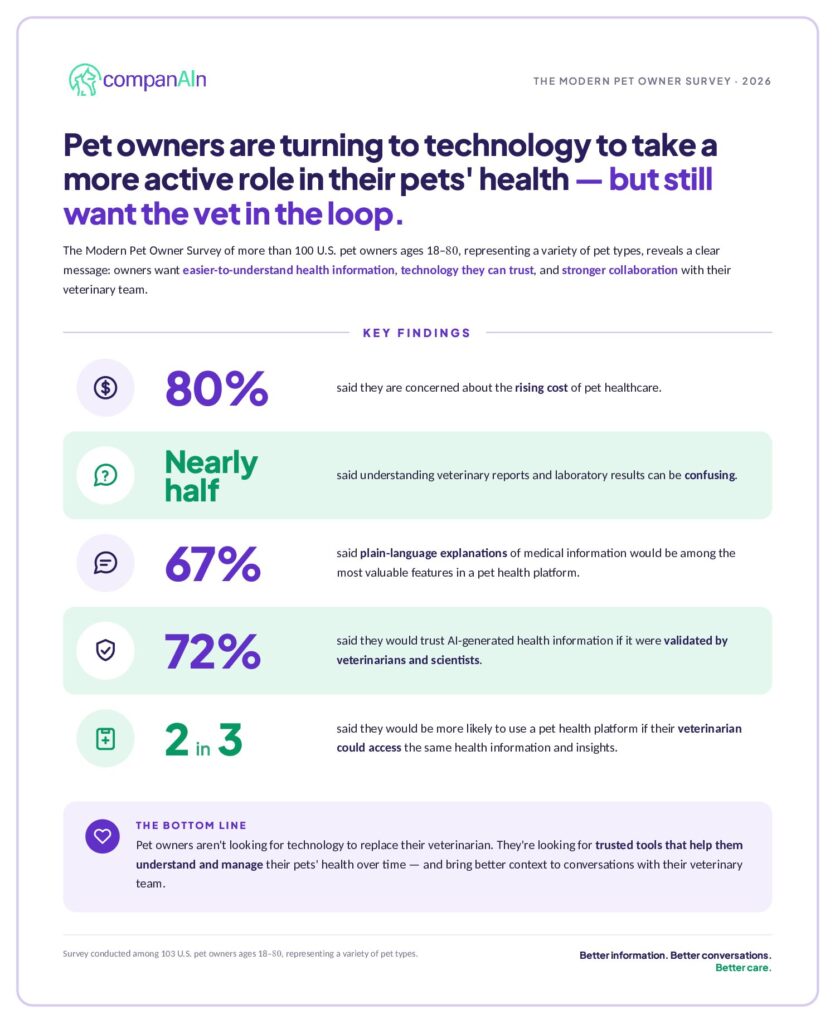

Veterinarians do not simply practice medicine. Vets dedicate their heart and soul to animals who cannot speak for themselves. It is not just their profession; it is woven into their being. They keep the human in humanity and the humane in healthcare. In a world increasingly shaped by technology, they are the ones who ensure that innovation is guided by empathy, not just efficiency. Their presence is what makes care not only smarter, but deeply kind.
As artificial intelligence matures, it is opening powerful new possibilities in veterinary care. From analyzing lab trends to organizing medical histories, AI can deliver a kind of clinical precision that would be difficult for even the most seasoned team to match manually. As we integrate more intelligent systems into the heart of medicine, we must not forget what makes care truly complete: the presence, intuition, and emotional intelligence of a human being.
Veterinary professionals do not just treat symptoms. They interpret stories. They read between the lines of lab results, behavior, and body language, and they offer care that considers not just what is measurable, but what is meaningful.

Agentic Systems Require Human Judgment
In the world of agentic AI, where multiple specialized agents reason, retrieve, and act semi-autonomously, having a human-in-the-loop is a requirement.
No matter how advanced an AI system becomes, it can still misinterpret context, overfit past examples, or fail to recognize subtle clinical nuances that fall outside its training data. Agents may incorrectly flag a benign variation as dangerous. They may overlook a rare but important anomaly. They may miss a pattern that only makes sense in light of a smell, a hesitation, or a moment of knowing something is just not right.
This is not a flaw in AI, but a truth of all complex systems, including human ones. But unlike a veterinarian, an AI model does not carry ethical responsibility or emotional accountability. It cannot feel the gravity of a decision, hesitate out of compassion, or pause because it senses uncertainty in the room. Even the most advanced agentic systems are driven by logic and training data and not moral reasoning.
This is why alignment, ensuring AI goals match human values, is not a luxury, but a necessity. It is why explainability matters in clinical contexts, where every recommendation should be traceable and defensible. And it is why fail-safe design, from escalation protocols to human-in-the-loop checkpoints, should be built into any system touching health or life.
Agentic workflows are strongest when they assist a person, not replace them. The veterinarian provides an interpretive layer that balances data with discernment.
Empathy Is Not a Feature — It Is a Foundation
Animals and their families need accuracy and assurance in moments of uncertainty. They want to know that the person guiding them sees the full picture, not only the clinical indicators, but the emotional weight behind every decision.
Veterinary professionals are often the bridge between science and love. They are the ones who translate medical insights into compassionate guidance. They are the ones who feel the pulse of the patient and the pulse of the room. A veterinarian’s ability to synthesize data, environment, emotion, and memory is something AI cannot solely replace — it is an invitation to collaborate.

AI Can Support and Humans Must Lead
Artificial intelligence can and should play a larger role in modern veterinary medicine. It can help surface overlooked patterns, reduce the burden of record review, and provide memory across time and visits. It can organize. It can predict. It can recommend.
To explore how AI is actively shaping veterinary workflows while supporting—but not replacing—human judgment, see our in-depth article on AI in veterinary practice.
It cannot replace the feeling of being seen, heard, and cared for.
The best systems will be those that preserve the very thing that makes care worthy of trust: the human presence. Not as an afterthought or a final sign-off, but as the core of the process. When animals are in distress, when families are searching for answers, and even when care goes smoothly, it is not the algorithm they will remember in the end.